
Vocational Courses After 10th: 9 That Pay in 2026
⏱ 11 min read
QUICK ANSWER
The best vocational courses after 10th in 2026 are the ones with a recognised NSQF level and a real hiring line behind them: ITI trades such as Electrician, Fitter and Mechanic (Motor Vehicle), a three-year polytechnic diploma, and NCVET-approved job roles in healthcare support, renewable energy and CNC machining. ITI pass-outs recorded 45.95% employability in the India Skills Report 2026, ahead of polytechnic diploma holders at 32.92%. Short private certificate courses with no NSQF level are the ones to skip.
Vocational courses after 10th are no longer the backup plan parents whisper about, and the 2026 numbers say so plainly. The India Skills Report 2026 puts ITI pass-out employability at 45.95%, up from 41% the previous year, while polytechnic diploma holders sit at 32.92%. Those two figures, from a report released by ETS with CII, AICTE and AIU, tell you more about your child’s next two years than any glossy college brochure will.
Register on Ayud Jobs & Get Hired Faster
Create your free profile, apply in one tap, and let recruiters find you. Your next opportunity is closer than you think.
I run career sessions for students and parents most weeks, and August is when this question arrives in bulk. The main admission round is done. The seat did not come, or it came in a trade nobody at home understands. Everyone is scrolling.
Every list of vocational courses after 10th you have already read gives you thirty course names and no way to judge them. This one gives you fewer names, the recognition level behind each, the money you can actually expect in year one, and the three routes I tell families to walk away from.
What Counts as Vocational Courses After 10th in 2026
India runs one national ladder for skills, called the National Skills Qualification Framework, or NSQF. It has levels from 1 to 8, and each level describes how much skill, knowledge and independence a qualification actually proves. The regulator is NCVET, which approves qualifications and the bodies allowed to award them.
That ladder is the whole game. A one-year ITI trade certificate, a three-year polytechnic diploma and a six-month skilling course are not equivalent, and all three families of vocational courses after 10th sit somewhere on this ladder. An NCVET diploma is pegged at level 4.5 and an advanced diploma at level 5.
So before you compare fees or hostel distance, ask the institute one question: what is the NSQF level of this qualification, and who awards it? If the answer is a shrug or a laminated brochure, you have your answer. That single question is the most useful filter for vocational courses after 10th, and almost nobody uses it.
The 2026 Data Nobody Puts in These Lists
Employability is not the same as placement, but it is the closest honest signal we have. The India Skills Report 2026 surveyed over one lakh candidates through the Global Employability Test and 1,000-plus employers across seven industries. This is the number that should decide your shortlist of vocational courses after 10th.
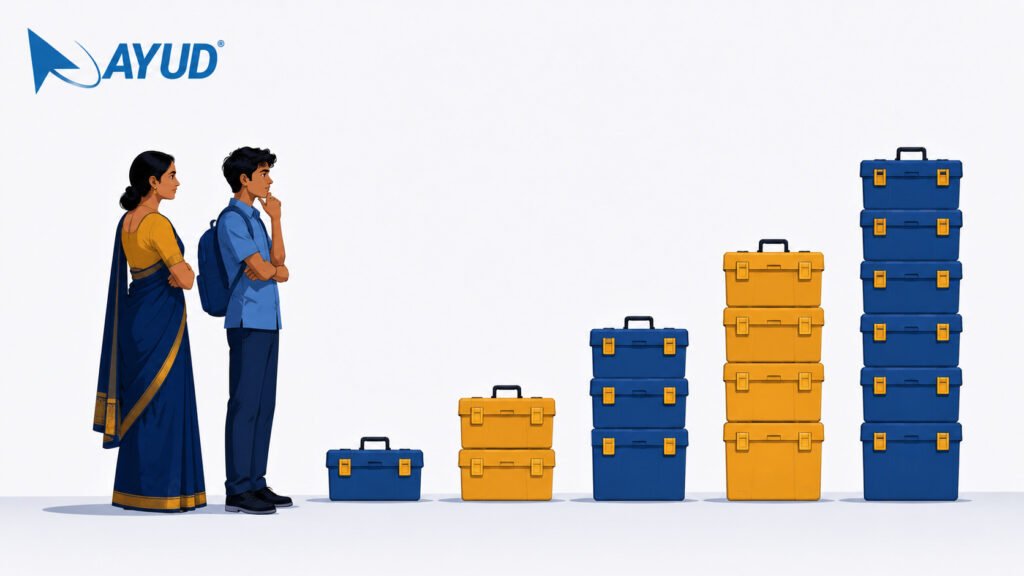
Now put it beside the money. The Board of Apprenticeship Training revised the minimum apprenticeship stipend from 1 April 2026, and the new floors are the first hard rupee figure a 10th-pass student can plan around.
| Route | Duration | Approx. NSQF level | Who certifies | 2026 outcome signal | Minimum stipend on apprenticeship (2026) |
|---|---|---|---|---|---|
| ITI trade certificate (CTS) | 1–2 years | 3 to 4 | DGT / NCVT | 45.95% employability, India Skills Report 2026 | ₹5,000–₹9,000 per month under NAPS |
| Polytechnic diploma | 3 years | 5 | State board of technical education | 32.92% employability, India Skills Report 2026 | ₹10,900 per month, NATS, w.e.f. 1 Apr 2026 |
| NSQF short-term skilling (PMKVY type) | 3–12 months | 3 to 4 | NCVET-approved awarding body | Approx. 22% placed: 24.38 lakh of 1.11 crore certified, Rajya Sabha reply, July 2026 | ₹9,600 per month for technician (vocational), NATS |
| School vocational stream (Class 11–12) | 2 years | 3 to 4 | State board under NSQF | Keeps the 12th certificate intact | Not applicable during study |
Read that table twice, because the gap between the three families of vocational courses after 10th is not small. A short private course and a two-year ITI trade are separated by roughly twenty percentage points of outcome, and the short course usually costs more.
Which Vocational Courses After 10th Are Worth It in 2026?
The vocational courses after 10th worth your two years share three things: an NSQF level you can verify, an apprenticeship pathway that pays a government-set minimum stipend, and a trade where local employers are actually short of hands. Electrician, Fitter, CNC machining, healthcare support and solar technician clear all three today. The nine-course breakdown below shows which of them fit which kind of student.
9 Underrated Options for 2026
Here are nine vocational courses after 10th I recommend most often, chosen because demand is real and the qualification is recognised, not because the name sounds impressive at a family function.
| # | Course or trade | Where you study it | Duration | Why it is underrated in 2026 |
|---|---|---|---|---|
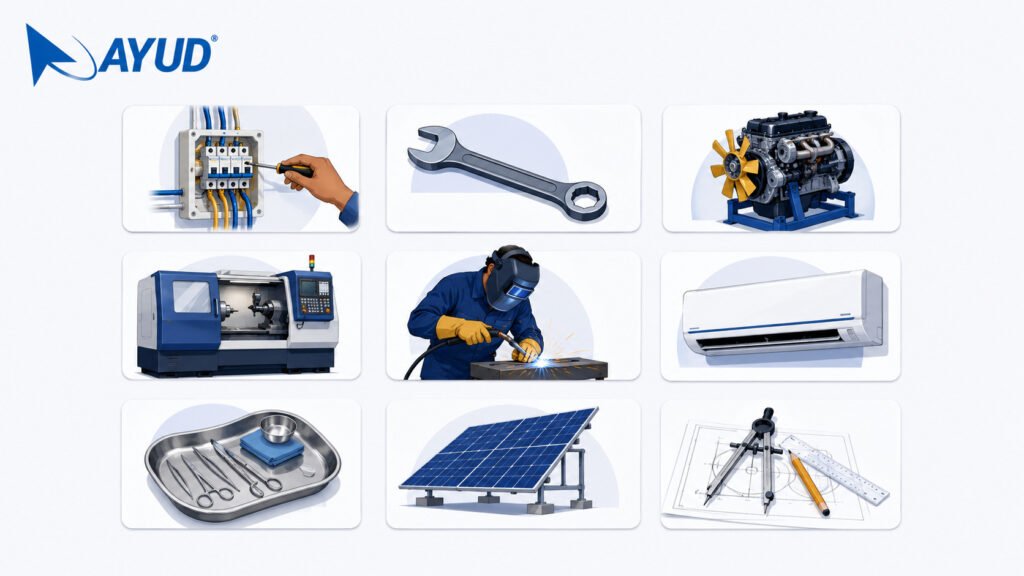
| 1 | Electrician | Government or private aided ITI | 2 years | Solar rooftop and EV charging work is pulling licensed electricians out of every district. Renewable energy is a top hiring sector in the India Skills Report 2026. |
| 2 | Fitter | ITI | 2 years | The default feeder trade into manufacturing apprenticeships and PSU technician posts. Boring name, widest door. |
| 3 | Mechanic (Motor Vehicle) | ITI | 2 years | Commercial fleets and EV service centres both hire from here, and self-employment after five years is genuinely achievable. |
| 4 | Machinist / Turner with CNC add-on | ITI plus a short CNC module | 2 years + 3 months | Skilled CNC operators stay scarce because most candidates stop at the base trade. The add-on is what changes your pay. |
| 5 | Welder, moving to 6G certification | ITI plus advanced certification | 1 year + upgrade | Entry is easy and crowded; the certified end is thin. This is the clearest skill ladder on the list. |
| 6 | Refrigeration and Air Conditioning technician | ITI | 2 years | Cooling demand grows every summer and the work cannot be offshored or automated away. |
| 7 | Healthcare support roles: lab, OT, dialysis assistant | NCVET-approved awarding body or paramedical institute | 1–2 years | Healthcare is a top hiring sector in 2026 and hospital demand is steady in tier-2 towns, not just metros. |
| 8 | Solar PV installer and technician | NSQF-aligned skilling centre | 3–6 months, best as an add-on | Strong as a second qualification on top of Electrician. Weak as your only certificate. |
| 9 | Polytechnic diploma: Civil, Mechanical, E and E | Government or private polytechnic | 3 years | Lower employability on paper, but the only route here with a clean lateral entry into second-year engineering. |
One thing worth saying to every parent reading this: none of these vocational courses after 10th closes the door on a degree. A diploma holder can enter engineering directly in the second year, and our guide to DCET 2026 Karnataka counselling walks through exactly how that entrance works.
The Ayud Lens: Scarcity, Balanced, Overvalued
I sort vocational courses after 10th into three buckets, and I have never found a family that did not immediately understand the framing.
- Scarcity — more employers than trained people. CNC machining, 6G welding, RAC technicians, solar-plus-electrician, dialysis and OT technicians. Pay rises fastest here because supply is thin.
- Balanced — steady demand, steady supply. Fitter, Motor Vehicle Mechanic, Draughtsman, most polytechnic diplomas. Safe, respectable, no windfall.
- Overvalued — heavily marketed, thinly employed. Generic computer operator and DTP certificates, three-month mobile repairing courses, private hospitality and aviation diplomas sold with placement promises.
The mistake I see is families choosing from bucket three because the advertisement was the most confident. Confidence in marketing usually signals weakness in outcomes.

Here Is the Catch
Three kinds of vocational courses after 10th disappoint almost every family that chooses them, and I would rather say this plainly than sell optimism.
First, unrecognised short certificates. If the course has no NSQF level and no NCVET-approved awarding body, the certificate is a receipt, not a qualification. Ask for the level in writing.
Second, courses sold on placement promises. Note that PMKVY 4.0 was formally delinked from placement guarantees after earlier versions reported weak numbers, and across PMKVY overall, 24.38 lakh of 1.11 crore certified candidates were reported placed, per the minister’s July 2026 Rajya Sabha reply. If a national scheme will not promise placement, a private institute in your town certainly cannot.
Third, stopping at the base trade. The employability figure for ITI is 45.95%, which also means more than half do not convert. The people who convert are the ones who add an apprenticeship, a CNC or 6G upgrade, and basic English and digital fluency on top of the trade.
Vocational Route Versus the Default PUC Route
Let me put vocational courses after 10th against the default PUC route honestly, because both are legitimate and the right answer depends entirely on the student in front of me.
| Question | Vocational route | PUC then degree |
|---|---|---|
| Time to first earning | 1–3 years | 5–6 years |
| Cost | Low in government institutes | Moderate to high |
| Earning while learning | Yes, through apprenticeship stipend | Rarely |
| Path to a degree | Open, via diploma lateral entry | Direct |
| Best suited to | Hands-on learners, families needing early income | Students strong in theory aiming at professional exams |
If your child scored well and enjoys theory, PUC is not a mistake. If your child fixes things at home and switches off in a lecture, forcing PUC is the mistake.
A Student I Met This Year
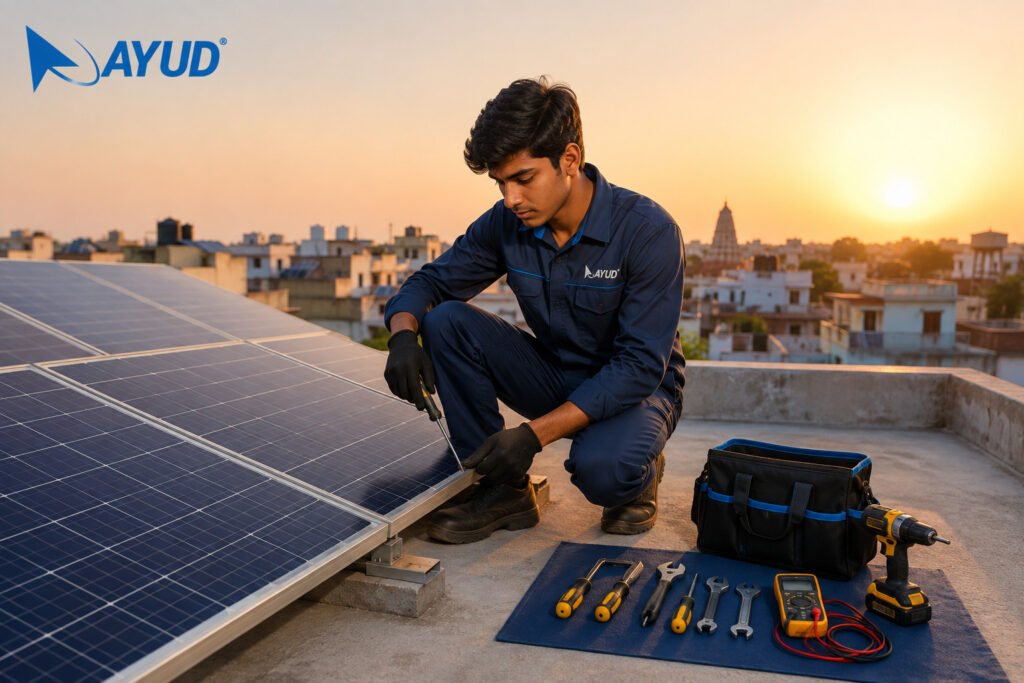
Basavaraj is from a village outside Kalaburagi, and he asked me about vocational courses after 10th two weeks after results. He had 58%, an uncle pushing him towards a private BBA, and no interest in either. What he did have was three years of quietly repairing pump motors for neighbours.
We looked at his actual behaviour rather than his marks. He took Electrician at a government ITI, added a solar PV module in the second year, and moved into an apprenticeship with a rooftop installer. His family stopped paying for his education in month fourteen. The uncle came around.
How to Apply in 2026
Applying for vocational courses after 10th in 2026 runs through three portals, and the timing matters more than the paperwork.
- ITI: in Karnataka, admissions to 270 government and 192 private aided ITIs are handled through cite.karnataka.gov.in on a merit-cum-reservation basis. The main window for the August 2026 session ran from 27 April to 8 May 2026, so if you are reading this now, ask your nearest ITI help desk about spot and vacancy rounds rather than assuming the door is shut. Our full guide to ITI admission 2026 in Karnataka covers eligibility and documents.
- Polytechnic diploma: apply through your state Directorate of Technical Education portal; Karnataka students admitted on merit of Class 10 marks.
- Apprenticeship: register on the national apprenticeship portal after or alongside your trade certificate. This is the step most students skip, and it is where the stipend lives.
Government schemes are moving in the same direction. PM-SETU, announced with a ₹60,000 crore investment to upgrade ITIs, tells you where public money is going for the next few years. Read the underlying employability figures in the India Skills Report 2026 coverage if you want the full picture before deciding.
Frequently Asked Questions
Are vocational courses after 10th a good idea for an average student?
Yes, and often a better one. Marks measure recall; trades reward practice. A student at 55% who enjoys hands-on work will usually out-earn a reluctant PUC student by year three, provided the qualification is NSQF-recognised.
Can I still do a degree later?
Yes. A three-year polytechnic diploma allows lateral entry into the second year of engineering through state entrance counselling, and open universities accept ITI pass-outs into degree programmes.
Which trade pays the most in the first year?
In year one, the differences are small because apprenticeship stipends are set by qualification level, not trade. From year three onward, scarcity trades like CNC machining, 6G welding and RAC pull ahead clearly.
Are short-term skilling courses worth the fee?
Only as an add-on. A three-month solar or CNC module on top of an ITI trade is excellent value. The same module as your only qualification leaves you competing with everyone else who took a shortcut.
Will these jobs survive AI?
The physical ones will outlast most desk roles. Nobody has automated crawling into a ceiling to fix ducting, wiring a rooftop array or repairing a gearbox. That is the quiet argument for the skilled trades in 2026.
What to Do This Week
Pick one trade from the scarcity bucket, call the nearest government ITI or polytechnic and ask two questions: is there a vacancy round open, and what is the NSQF level of the qualification. Ten minutes on the phone beats ten hours of scrolling.
If you are still torn between the vocational and academic routes, our guide on how to choose a career after 10th walks a parent through the decision step by step. Because in the end, the right vocational courses after 10th buy you a skill, a stipend and a second door into a degree, all at once.
Not sure which bucket your child belongs in?
Take the free GoTestIt self-assessment to see whether you learn better by doing or by studying, or book a Clarity Session and we will map the trade to your district’s actual hiring, not a generic list.
Register on Ayud Jobs & Get Hired Faster
Create your free profile, apply in one tap, and let recruiters find you. Your next opportunity is closer than you think.