GTTC Courses After 10th: 2026 Fees & the Catch
⏱ 11 min read
In Short (Quick Answer)
GTTC courses after 10th are AICTE-approved technical diplomas run by Karnataka’s Government Tool Room and Training Centre, a state institution set up in 1972 with support from the Government of Denmark. Six diploma streams exist across the state network, but no single centre runs all six. Selection is on SSLC merit, not an entrance test. The catch nobody tells you: the machine hours matter more than the certificate, and the India Skills Report 2026 puts polytechnic diploma employability at just 32.92%.
If you are weighing GTTC courses after 10th for your son or daughter this admission season, here is the number that should shape your decision: the India Skills Report 2026 rates polytechnic diploma holders at 32.92% employability, against 45.95% for ITI candidates and 70.15% for engineering graduates. A diploma certificate by itself is not a job. What separates a GTTC diploma from an ordinary one is the hardware behind it.
Register on Ayud Jobs & Get Hired Faster
Create your free profile, apply in one tap, and let recruiters find you. Your next opportunity is closer than you think.
I sit with families in Kalaburagi almost every week during counselling season. The same question comes up about GTTC courses after 10th: is this tool room place actually different, or is it just another government polytechnic with a longer name? This post answers that honestly, including the parts the college listing sites leave out.
GTTC Courses After 10th: The Complete 2026 List
GTTC’s own website lists six diploma streams across its network of more than 30 centres. Every one of these GTTC courses after 10th is open to a student who has passed SSLC. There is no entrance exam.
| Diploma Stream | What You Actually Work On | Ayud Value Lens |
|---|---|---|
| Tool and Die Making | Dies, moulds, jigs, fixtures on CNC and conventional machines | Scarcity |
| Precision Manufacturing | Tight-tolerance machining, grinding, metrology, CMM inspection | Scarcity |
| Mechatronics | Hydraulics, pneumatics, PLC, sensors, machine maintenance | Balanced |
| Automation and Robotics | Robotic cells, industrial automation, controls | Balanced |
| Artificial Intelligence and Machine Learning | Python, software development, robotics applications | Balanced |
| Electronics and Communication | Circuits, embedded systems, instrumentation | Balanced |
Two things the listing portals rarely say out loud. First, course duration is not uniform: Tool and Die Making is listed as a four-year programme at several centres while other diplomas run three years, so confirm the duration in writing at the centre you apply to. Second, at Bangalore the Electronics and Communication diploma has been offered exclusively to girls with an intake of 50 seats, which is a genuine opening for daughters in tier-2 districts.

What GTTC Actually Teaches: Inside a Training Day
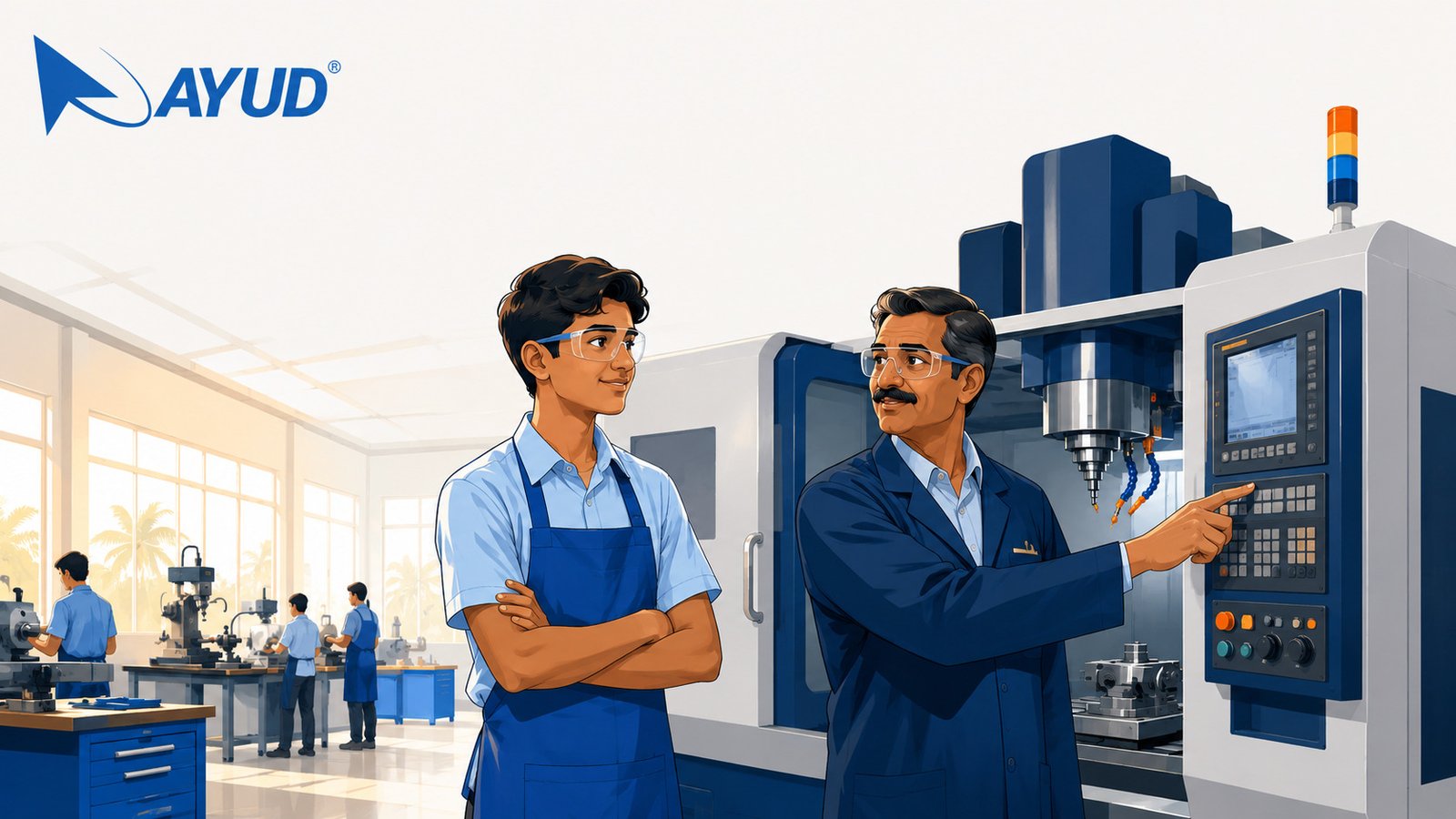
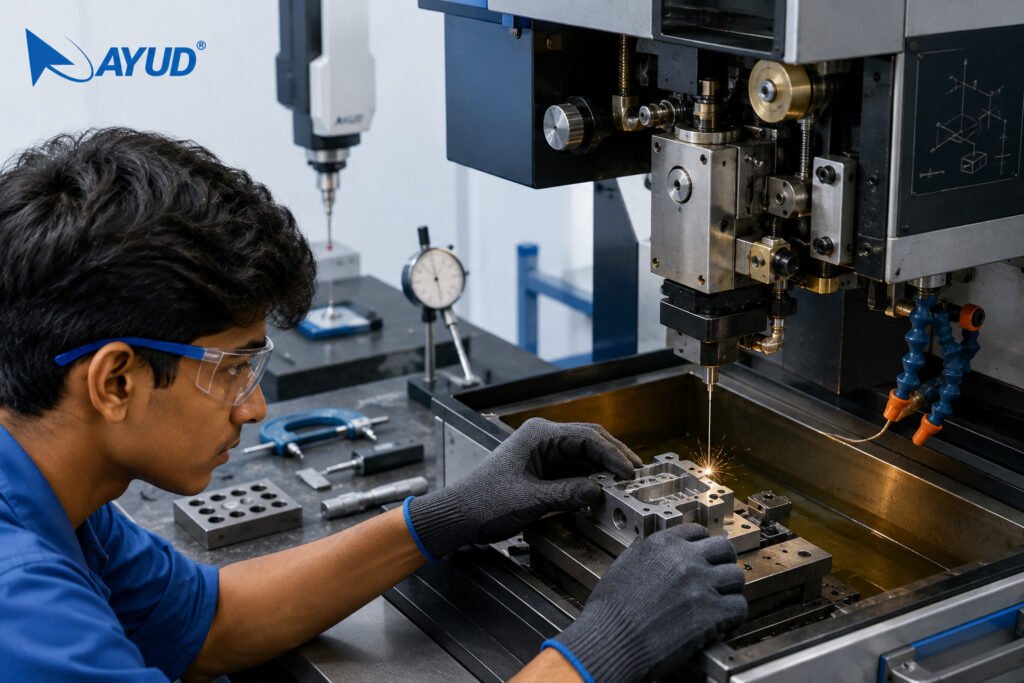
This is where GTTC courses after 10th separate from a standard polytechnic. GTTC is a working tool room that sells precision components to industry. Students learn on the same machines that fill live customer orders.
The centres are equipped with 3-to-5 axis high-speed CNC machining centres, CNC turning and turn-mill centres, CNC jig grinding, CNC spark erosion, wire EDM, coordinate measuring machines, profile projectors and high-power lasers for cutting and engraving. On the software side the curriculum runs on CATIA, Creo, Unigraphics, SolidWorks, MasterCAM, AutoCAD and Ansys.
Read that list again as a parent. Those are the exact tools a manufacturing employer in Bengaluru, Pune or Hosur advertises for. A boy who has personally set up a wire EDM job and cleared a CMM inspection has something to say in an interview. A boy with only a mark sheet does not.
Beyond the long diplomas, GTTC courses after 10th also include short-term competency courses that most families never hear about: Tool Room Machinist, Tool and Die Technician, CNC Operator Turning, CNC Programmer, conventional milling, surface grinding and fitter trades. Turner, miller, grinder and fitter programmes have been run as four-month courses. There are also government-sponsored routes, including the Chief Minister’s Kaushalya Karnataka Yojane scheme for educated unemployed candidates and a dedicated skill training programme for SC and ST candidates.
The Kalaburagi Reality: Not Every Centre Runs Every Course
Here is the single most useful correction I can give you about GTTC courses after 10th, and it is the reason families waste application fees. The six-stream list is the state list. Your local centre runs a subset of it.
The Kalaburagi centre, listed in GTTC’s network as Gulbarga STU-07, has operated in the city since the late 1990s. College data platforms currently list it with two diploma streams, Tool and Die Making and Precision Manufacturing, not the full six. If your child has set his heart on Automation and Robotics or AI and ML, that may mean relocating to Bengaluru, Belagavi or Devanahalli. Verify the running streams for the current intake by phone before you fill the form.
What Kalaburagi does have, alongside its GTTC courses after 10th, is industry connection. The centre houses a Siemens Centre of Excellence lab and an SAP centre. Sharnbasva University signed an MoU under which 150 engineering students were taking training and internships at the Kalaburagi GTTC facility, in blocks ranging from 50 to 300 hours, with placement support attached. In December 2024 GTTC and Gulbarga University signed an MoU for a Multi-Skill Development Centre on 25 acres at a cost of Rs 120 crore, under the theme “Local Skills, Global Jobs”, with similar centres planned at Tallakal in Koppal and Varuna in Mysuru.
For a Kalyana Karnataka family, that matters. It means the skilling infrastructure is moving toward you instead of away from you.
GTTC Courses After 10th vs Polytechnic vs ITI: The Honest Comparison
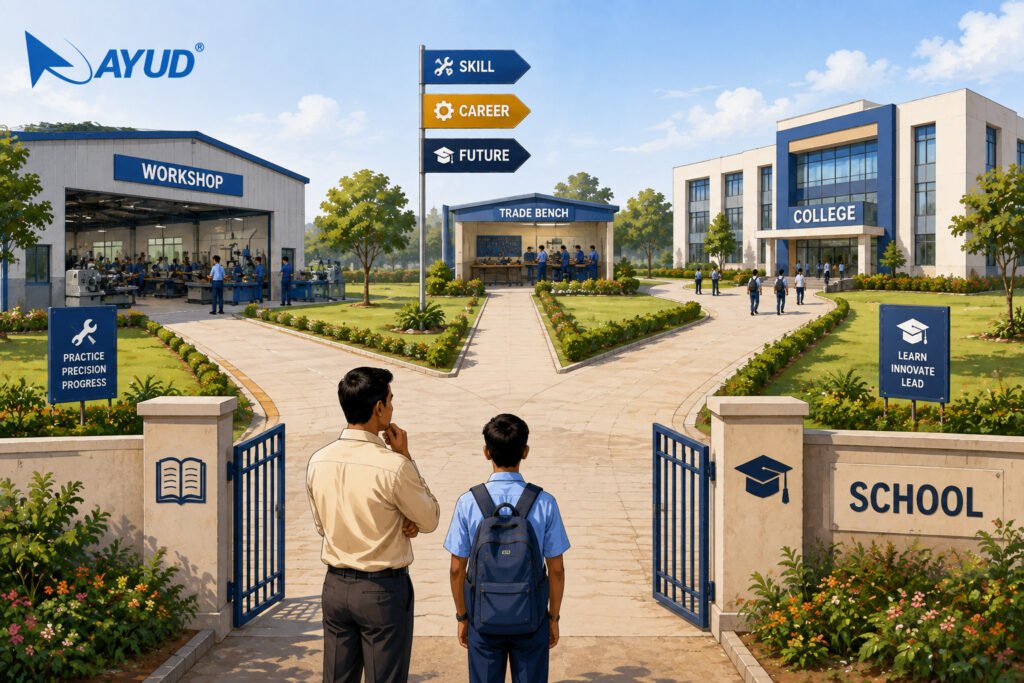
Parents ask me to rank GTTC courses after 10th against the other two routes. The data does the ranking better than I can. These are national employability figures from the India Skills Report 2026, the 13th edition, released by ETS with CII, AICTE, AIU and Taggd, based on over one lakh candidate assessments.
| Route | Employability (India Skills Report 2026) | What Decides Your Outcome |
|---|---|---|
| Engineering (BE/BTech) | 70.15% | Branch and internships |
| National average, all streams | 56.35% | Digital and AI fluency |
| ITI | 45.95% | Trade demand in your region |
| Polytechnic diploma | 32.92% | Machine hours and workshop quality |
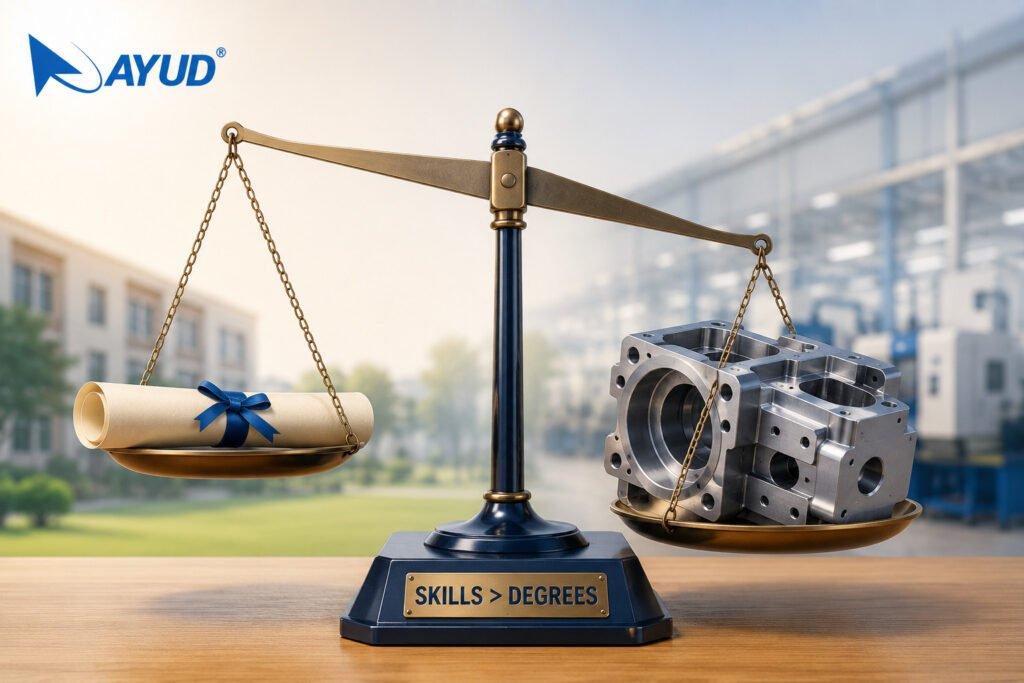
Look at the bottom row. Polytechnic diploma holders are the weakest group in that table. That is precisely the argument for GTTC courses after 10th rather than against them: within a category where the average is poor, the deciding variable is how much real machine time the institution gives you, and a working tool room gives more of it than a classroom-first polytechnic. Manufacturing also remains one of the top hiring sectors in the same report, with overall employer hiring intent for FY 2026-27 at 40%, up from 29% the previous year.
If your child wants a shorter, trade-first route instead, compare this with ITI admission 2026 in Karnataka before deciding. And if the plan is diploma now, engineering degree later, read how DCET 2026 lateral entry in Karnataka works, because that exam is the bridge from a diploma to the second year of a BE.
Are GTTC Courses After 10th Worth It in 2026?
Yes, for a student who genuinely enjoys machines and hands-on work. GTTC courses after 10th deliver AICTE-approved diplomas taught inside a commercial tool room, on CNC, EDM and CMM equipment most polytechnics cannot afford. The worth depends entirely on the branch you pick and the centre you attend, not on the GTTC name alone.
GTTC Fees After 10th and How to Apply
Fee transparency is poor across the internet, and this is where families get an unpleasant surprise. Published figures for GTTC courses after 10th vary enormously by source and by centre. Treat the table below as a range to verify, not a quotation.
| Cost Item | Figure Reported | Source |
|---|---|---|
| Diploma tuition, total | Rs 12,810 | Shiksha listing, 2025 |
| Diploma first-year fee | Rs 19,250 | Collegedunia, GTTC Bangalore |
| Polytechnic course fee | Rs 40,215 | Collegedunia, 2023-24 session |
| Diploma fee, other centres | Rs 71,000 to Rs 2.69 lakh | Careers360, Gauribidanur and Udupi |
| Application form | Rs 500 | Collegedunia admission page |
| Refundable tool and instrument security | Rs 3,000 | Collegedunia admission page |
Why the spread in GTTC courses after 10th fees? Different centres, different course lengths, different years of data, and portals that mix tuition-only with all-inclusive figures. Ask the centre for a written fee break-up covering all years before you pay anything.
The admission route itself is simple. You need an SSLC pass, and the Karnataka rules generally require a minimum of five years of study in the state. Selection runs on a merit-cum-roster system built from SSLC marks. Applications typically open around the SSLC result in May and run through June and July, with later rounds where seats remain. Keep the SSLC marks card, transfer certificate, study and domicile certificates, caste and income certificates where applicable, and passport photos ready. Apply through the official GTTC portal, and cross-check the wider diploma calendar on the DTE Karnataka technical education site.
The Catch: What I Tell Parents Before They Say Yes
I am not going to sell you a dream. There are three honest catches with GTTC courses after 10th.
First, the placement figures are modest by IT standards. Reported GTTC Bangalore placement data for 2022-23 shows 115 students placed on and off campus, with packages running from about Rs 1.8 lakh to Rs 6 lakh per annum, at companies including L&T, Volvo, Emerson, BEL, Wipro and TCS. That is a real starting wage in manufacturing, not a software salary. Judge it against a diploma cohort, not against an engineering campus.
Second, this is physical work. Standing at a machine, oil, metal, shift timings and a four-year commitment in some branches. A student who dislikes workshops will be miserable, and no brand name fixes that.
Third, applying the Ayud lens: Tool and Die Making and Precision Manufacturing sit in the Scarcity zone, because few institutions produce people who can hold tight tolerances. Mechatronics, Automation and AI sit in the Balanced zone, useful but increasingly crowded. What is genuinely Overvalued is any generic computer diploma taken because it sounds modern. In an economy where over 90% of employees already use generative AI tools, the durable advantage is doing something a laptop cannot do from a distance.
One Kalaburagi Story
Two years ago a father from Afzalpur came to me with his son, who had scored 58% in SSLC. The father wanted a BSc, then a government job. The son had spent his childhood repairing water pump motors in the village.
We looked at the boy, not the average. He joined a tool room track. In the first year he was slow and his father called me twice, worried. By the third year he was the one his batch asked to set up the machine. He now works in a Bengaluru precision unit on a starting package that is unremarkable on paper and life-changing in his household, and his father recommends the route to everyone in the village.
That is the pattern I keep seeing. GTTC courses after 10th reward the student who likes the work. They punish the student who was pushed into it.
Frequently Asked Questions
Is there an entrance exam for GTTC courses after 10th?
No. Admission runs on SSLC merit through a merit-cum-roster system. There is no separate entrance test for the diploma intake.
Can a girl student apply?
Yes. Girls are eligible across streams, and the Electronics and Communication diploma at Bangalore has been offered exclusively to girls with a 50-seat intake.
Are GTTC diplomas AICTE approved?
Yes. GTTC courses after 10th are approved by the All India Council for Technical Education, and several centres carry NBA accreditation.
Can I do engineering after a GTTC diploma?
Yes. Clear DCET and you enter the second year of a BE through lateral entry. Many tool room students take this route while already earning.
Which is the best branch among GTTC courses after 10th?
For scarcity value, Tool and Die Making and Precision Manufacturing. For a student drawn to controls and software, Mechatronics or Automation and Robotics. Confirm which streams your nearest centre actually runs.
What To Do Next
Do not choose from a brochure. Visit the centre, stand in the workshop for ten minutes and watch your child’s face. If he leans toward the machines, GTTC courses after 10th are one of the strongest value-for-money decisions available to a North Karnataka family in 2026.
Not sure if your child is built for a tool room?
Take the free GoTestIt aptitude check, or sit with a counsellor and map the next four years properly instead of guessing during counselling week.
Book a Clarity Session or register free on Ayud and get the Kalaburagi diploma shortlist.
Register on Ayud Jobs & Get Hired Faster
Create your free profile, apply in one tap, and let recruiters find you. Your next opportunity is closer than you think.