Tool and Die Maker Salary India: 2026 to Year 5
⏱ 11 min read
In Short (Quick Answer)
The tool and die maker salary india range in 2026 starts at roughly ₹15,000–₹22,000 a month for a fresh diploma holder and reaches ₹30,000–₹45,000 a month by year five. PayScale puts the national median at ₹3.54 lakh a year, with the top 10% crossing ₹5.42 lakh. Before your first salary, GTTC’s compulsory fourth-year in-plant training pays a stipend of about ₹9,000–₹17,500 a month.
The catch: manufacturing took only 5% freshers in its 2026 hiring plans (India Skills Report 2026). The diploma is not what gets you paid. The shop-floor hours behind it are.
Register on Ayud Jobs & Get Hired Faster
Create your free profile, apply in one tap, and let recruiters find you. Your next opportunity is closer than you think.
Every week a parent asks me about the tool and die maker salary india websites are quoting, and almost every week they have already read three sites that gave three different answers. One said ₹21,500. One said ₹24,226. One said ₹8.65 lakh. All three are real numbers. All three are useless without context.
I sit with students in Kalaburagi, Yadgir and Raichur who are choosing between a GTTC diploma and a regular polytechnic. So let me give you the version I give them — what you earn in year one, what changes by year five, and where the money stops if you stop learning.
What Is the Average Tool and Die Maker Salary India Pays in 2026?
A fresh diploma holder earns ₹15,000–₹22,000 a month in 2026, while PayScale puts the national median at ₹3.54 lakh a year and the 90th percentile at ₹5.42 lakh. That gap is not an error. It is the five-year experience curve, and the table below shows exactly where a beginner sits on it and how fast they move.
This is the part the salary websites never explain. They publish one average for a job where a first-year trainee and a twelve-year tool room in-charge are counted in the same column. Any single tool and die maker salary india average therefore hides two very different people. In this trade the distance between those two people is bigger than in almost any other diploma career in India.
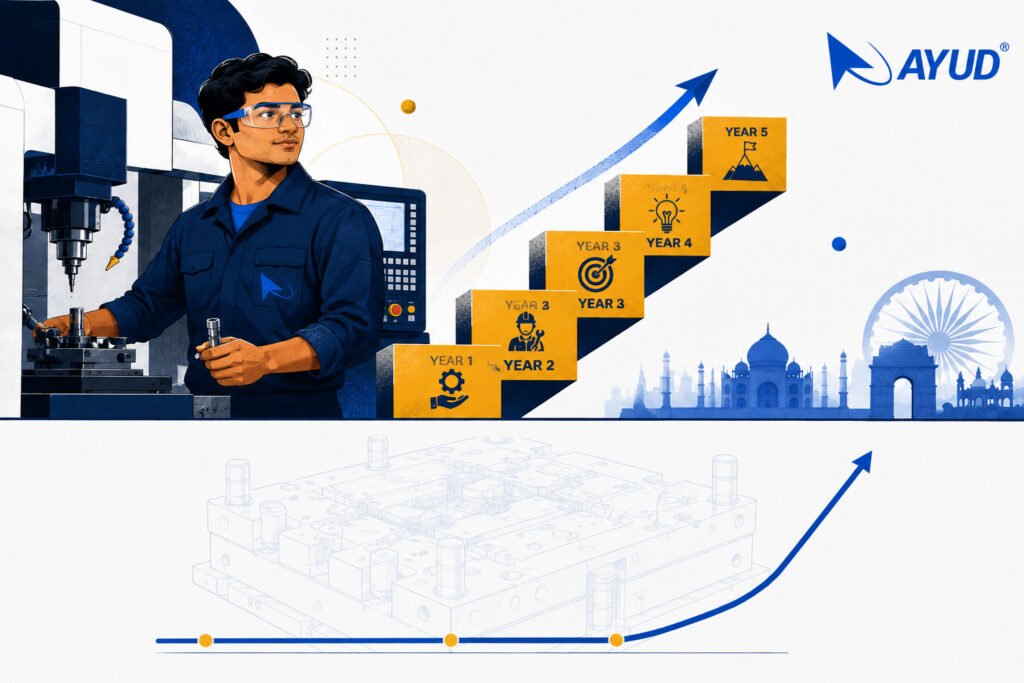
Tool and Die Maker Salary India: Entry to the 5-Year Path
Here is the progression I actually see in North Karnataka and Pune-belt tool rooms in 2026. I have built this tool and die maker salary india table from GTTC’s published in-plant stipend data, GTTC Bangalore’s 2022–23 placement spread (₹1.8 lakh lowest to ₹6 lakh highest package), Indeed India’s 2026 monthly average of ₹24,226, and PayScale’s India data for early, mid and experienced levels.
| Stage | Typical monthly pay (2026) | Annual equivalent | What you are actually doing |
|---|---|---|---|
| 4th year — in-plant training | ₹9,000–₹17,500 (stipend) | ₹1.1–2.1 L | Trainee on the shop floor, one year, mandatory |
| Year 0–1 — fresh diploma | ₹15,000–₹22,000 | ₹1.8–2.6 L | Conventional machines, deburring, basic fitting, assisting |
| Year 2–3 | ₹22,000–₹30,000 | ₹2.6–3.6 L | Independent on CNC/EDM, reading drawings, holding tolerance |
| Year 4–5 | ₹30,000–₹45,000 | ₹3.6–5.4 L | Die maintenance, trials, problem-solving on live tools |
| Year 8+ — senior | ₹45,000–₹85,000+ | ₹5.4–10 L | Tool designer, tool room in-charge, or your own job-work unit |
Read that table sideways, not downwards. The tool and die maker salary india curve is flat and frankly disappointing for two years, then it bends sharply. Most students who quit, quit in month fourteen — right before the bend.
Why Every Tool and Die Maker Salary India Figure Online Is Different
I get this question constantly, so here is the reconciliation nobody publishes. Each source reporting a tool and die maker salary india figure is measuring a different population with a different method, and once you see that, the confusion disappears.
| Source (2026 data) | What it reports | Why the number looks strange |
|---|---|---|
| Indeed India | ₹24,226 per month, 44 salaries reported | Monthly and self-reported; a small sample skewed to organised firms |
| PayScale India | ₹3,53,749 per year median | Annual base pay only; excludes overtime, which is real money in tool rooms |
| Glassdoor India | ₹21,500 “per year”, 68 salaries | Labelled yearly but sits in the monthly band — read it as a monthly figure |
| SalaryExpert (ERI) | ₹8,65,187 per year average | Employer-survey data weighted to large plants and senior toolmakers |
| GTTC placement record | ₹1.8 L lowest to ₹6 L highest package (2022–23) | Real institute data, but mixes freshers with lateral and experienced hires |
So when someone quotes you a single tool and die maker salary india number, ask two questions: monthly or yearly, and how many years of experience. Without both, the figure means nothing. Overtime matters here too — in a busy tool room it can add 15–25% to take-home, which is why the same worker reports very different numbers on two different sites.

What You Earn Before Your First Salary: The Stipend Year
This is the part most parents do not know, and it changes the maths completely. A GTTC diploma in Tool and Die Making is three years at the institute plus one compulsory year of in-plant training in industry, as stated on GTTC’s own diploma page.
That fourth year is paid. GTTC Dandeli has reported fourth-year students deputed with stipends of ₹11,000 to ₹17,500 a month, and Collegedunia’s data on GTTC Bangalore puts the average internship stipend near ₹9,000. Diploma fees at GTTC centres sit in the ₹19,000–₹35,000 per year band depending on the centre, so a large part of the course cost comes back in that final year. No salary website counts this stipend year when it publishes a tool and die maker salary india average.
It also does something no classroom can. It converts you from a fresher into someone with twelve months of industrial experience on the day you graduate — and most students are absorbed by the same company they trained in. That paid year is why the tool and die maker salary india curve starts higher for a GTTC student than for a paper-only diploma holder. If you are still deciding on the course itself, read GTTC admission, fees & eligibility 2026 before the counselling window closes.
The Catch: The Diploma Alone Does Not Get You Paid
I promised honesty, so here it is. The India Skills Report 2026 puts polytechnic diploma employability at 32.92% and ITI at 45.95%. In the same report, manufacturing planned just 5% of its hiring for freshers, focusing instead on skilled, experienced talent.
Read those two facts together and the tool and die maker salary india story becomes clear. Manufacturing is hiring, but it is not hiring beginners — it is hiring people who already have hours on a machine. That single sentence explains why two students from the same batch end up ₹12,000 a month apart within three years.
So the mandatory in-plant year is not a formality to be endured. It is the entire reason a GTTC or NTTF-trained candidate walks past the 32.92% wall while a paper-only diploma holder gets stuck behind it, and it is the single biggest lever on your tool and die maker salary india in the first three years. If you are comparing routes, our guide to ITI admission in Karnataka 2026 covers the lateral-entry path — ITI candidates can enter the second year of a GTTC diploma, and 20% of diploma seats are reserved for lateral entry.
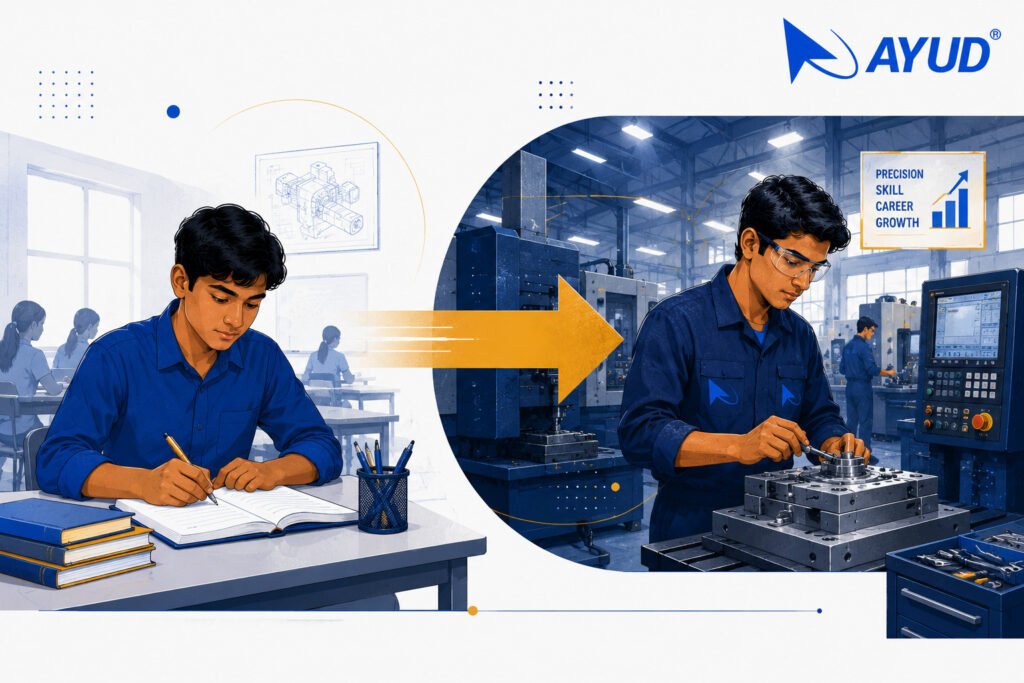
Scarcity, Balanced or Overvalued? Where This Trade Really Sits
At Ayud I grade every career on one simple lens: is the supply of trained people smaller than demand (Scarcity), roughly equal (Balanced), or far larger than demand (Overvalued)? Tool and die making sits firmly in Scarcity — and it has for a decade. That scarcity is exactly what holds the tool and die maker salary india curve up after year three.
TAGMA India’s leadership has said publicly that the country faces a paradox: millions of young people hunting for jobs while tool rooms cannot fill orders for lack of skilled manpower. Market research on India’s dies and moulds sector through 2030 names the same constraint — a persistent shortage of people who can run advanced high-speed milling and CNC equipment.
Now compare that with a generic private B.E. in a crowded branch, where thousands graduate each year into the same interview queue. That is what Overvalued looks like. Scarcity is why a good toolmaker with eight years never struggles for work, and why this trade resists AI far better than most desk jobs — a robot can generate a design, but somebody still has to hold a tolerance of two microns on a real block of steel at 2 a.m. Want a fuller comparison of the courses themselves? See GTTC courses explained: Tool & Die, CNC, Mechatronics.
Rahul from Yadgir: What Five Years Actually Looked Like
Rahul came to me after SSLC with 68% and a father who wanted him to do PUC and “then engineering, somehow.” He took a GTTC diploma instead. Three years at the institute, then his fourth-year in-plant training at an auto-component supplier near Belagavi on a ₹12,000 stipend.
The same firm absorbed him at ₹18,500 a month. Year two he was still at ₹21,000 and he called me, discouraged, asking whether his friends in B.Com were doing better. Year three he learned Mastercam properly and moved to a mould shop in Pune at ₹29,000. Today, in his fifth year, he is at ₹38,000 plus overtime and is being trained on tool design.
His father earns less than he does. That is the real tool and die maker salary india story — not a single average, but a slow first act and a steep second one. Rahul’s full route is mapped in our piece on going from SSLC to a precision-manufacturing job.
How to Push Your Tool and Die Maker Salary India Higher, Faster
Five things separate the students who reach ₹45,000 by year five from the ones still at ₹24,000:
- Pick the in-plant company carefully. A press-tool shop teaches you more in twelve months than a general fabrication unit teaches in three years.
- Learn design software early. SolidWorks, UGS/NX and Mastercam move you from operator pay to designer pay. GTTC teaches these — most students simply do not practise them.
- Say yes to night shifts and trials. Tool trials are where problem-solving is learned, and problem-solvers get promoted.
- Move once, around year three. Loyalty is rewarded slowly in tool rooms; the biggest single jump most people get is a switch, not an increment.
- Aim at aerospace, medical or electronics tooling. These pay above automotive because tolerances are tighter and imports are still heavy.
Not sure whether precision manufacturing suits your temperament at all? Take the free GoTestIt self-assessment on Ayud before you fill a single admission form. Ten minutes there saves three wasted years. Every one of those five moves shows up in your tool and die maker salary india inside eighteen months.
Frequently Asked Questions
Is the tool and die maker salary india offers better than a regular polytechnic diploma?
In the first two years, barely. From year three onward, yes — clearly. The difference comes from the compulsory in-plant training year and the scarcity of trained toolmakers, which pushes experienced pay well past general mechanical diploma roles.
What is the starting salary after a GTTC diploma in 2026?
Expect ₹15,000–₹22,000 a month. GTTC’s own reported placement packages start near ₹1.8 lakh a year and go up to ₹6 lakh for stronger or lateral-entry candidates, which is the realistic tool and die maker salary india starting band in 2026.
Will AI and automation kill this job?
Automation is changing it, not killing it. CNC, EDM and CAD have been standard for years and the shortage still exists. Setting, proving and maintaining tools remains hands-on work, which is why the tool and die maker salary india outlook is holding up better than many office roles.
Can an ITI candidate join a GTTC diploma?
Yes. ITI holders are eligible for lateral entry directly into the second year, and 20% of diploma seats are reserved for that route. It is the fastest way to convert an ITI certificate into a tool room career.
Which cities pay the most?
Pune, Chennai, Bengaluru and the Gurgaon–Manesar belt pay the highest, driven by automotive and electronics tooling. Bengaluru salaries run roughly 11% above the national average according to ERI SalaryExpert’s 2026 India data, so the tool and die maker salary india figure you plan around should match the city you intend to work in.
The Bottom Line
If you want a big number in year one, this is the wrong career — go where freshers are paid a premium. If you want a skill that is scarce, hard to automate, portable across the country and steadily compounding, the tool and die maker salary india path is one of the strongest returns available to a student who finishes SSLC with average marks and above-average hands.
The mistake I see most often is not choosing wrong. It is choosing blind — picking a course because a neighbour’s son did it, then discovering at 22 that the fit was never there. Knowing the tool and die maker salary india numbers is useful; knowing whether the work suits your hands and temperament is what decides the outcome.
Book a Clarity Session with our team and we will map your marks, your district and your family’s budget against the three or four routes that actually fit you — GTTC, ITI, polytechnic or PUC. Book your Clarity Session here, or ask your question directly on the Ayud app.
Register on Ayud Jobs & Get Hired Faster
Create your free profile, apply in one tap, and let recruiters find you. Your next opportunity is closer than you think.