
Tool Room Machinist Course: Easy 2026 Entry
⏱ 10 min read
Quick Answer: The tool room machinist course is a one-year GTTC certificate in Karnataka, open to SSLC pass and SSLC fail candidates. It trains you on lathes, milling and CNC machines, and GTTC provides job assistance on completion.
The tool room machinist course is the shortest legitimate route from a Class 10 marks card to a precision-manufacturing job in Karnataka, and almost nobody outside the shop-floor world knows it exists. It runs for one year at Government Tool Room and Training Centre (GTTC) campuses, it costs a fraction of a diploma, and at several centres it accepts students who did not clear SSLC at all.
I have sat with a lot of Karnataka parents in August. The conversation is nearly always the same. The polytechnic allotment did not come through, the ITI seat went to someone with two marks more, and the family is staring at a year that suddenly has nothing in it. This is the course I bring up in that room, and it is the one they have never heard of.
Register on Ayud Jobs & Get Hired Faster
Create your free profile, apply in one tap, and let recruiters find you. Your next opportunity is closer than you think.
So let me lay out the tool room machinist course properly — what it is, who can get in, what it costs, what it pays, and the part nobody puts on a college website.
What is the tool room machinist course, and who is it really for?
A tool room is the department that makes the tools that make everything else — the dies that stamp a car door, the moulds that form a syringe barrel, the jigs that hold an aircraft bracket steady while it is drilled. A machinist in that room works to tolerances measured in microns, on components that are made once and must be perfect.
The tool room machinist course trains you for exactly that room. GTTC lists it among its short-term technical courses alongside Tool & Die Technician, CNC Operator Turning, CNC Programmer, Conventional Turning Operator and Conventional Surface Grinding Machine Operator. It is a certificate programme, not a diploma, and that distinction matters — it is faster and cheaper, but it does not carry AICTE diploma equivalence.
The tool room machinist course suits three students in particular: the one who missed diploma and ITI allotment this season, the one who cannot afford three or four years without income, and the one who is simply better with their hands than with a textbook and has been told their whole life that this is a problem. In a tool room it is not a problem. It is the job.
Tool room machinist course eligibility in Karnataka 2026
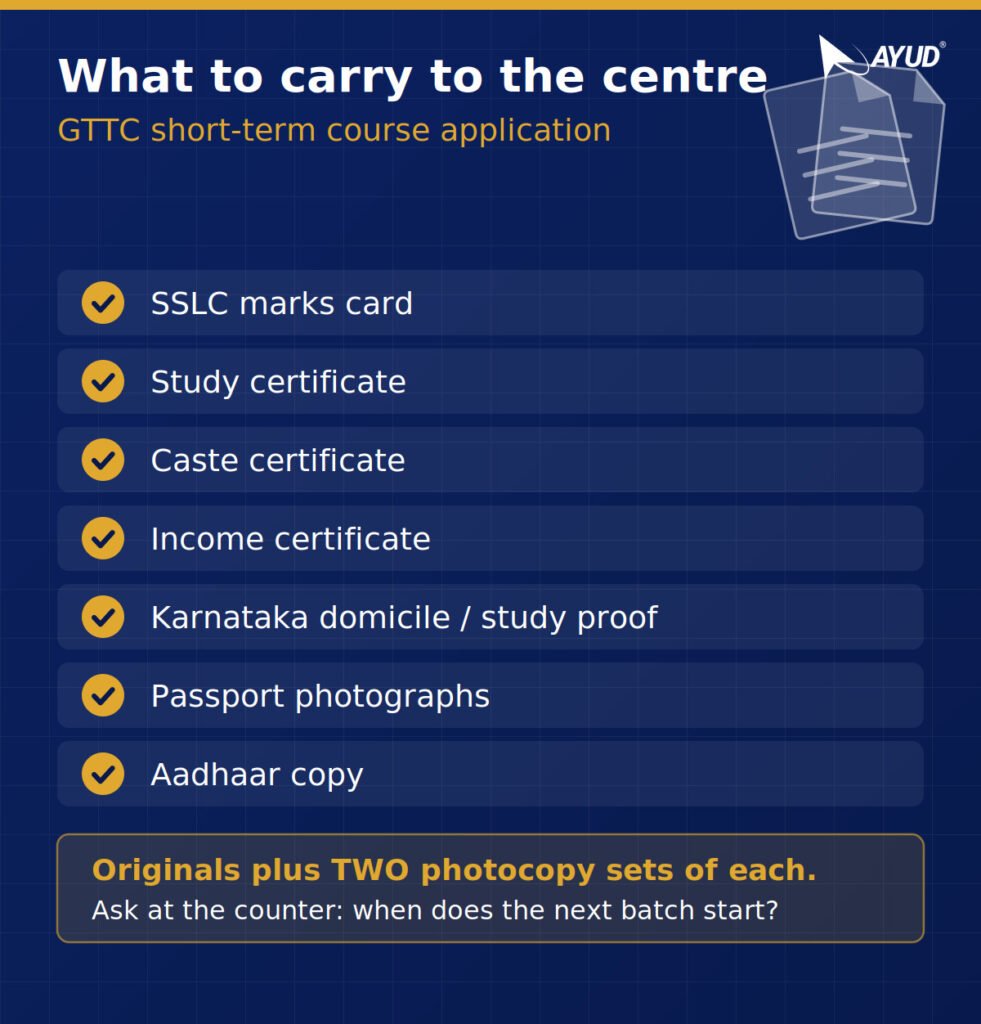
Here is the single most important fact on this page, and the one every national education portal gets wrong: GTTC has advertised its one-year tool room machinist course for candidates who have passed or failed SSLC, targeting unemployed candidates from low-income households, with free job assistance on completion.
Compare that with what the big aggregator sites tell you. Careers360’s pages for GTTC Kolar and GTTC Kanakapura state that admission needs 10+2 or PUC “with science and maths as the main subjects” — and their Kanakapura page openly hedges that the process “would most probably” work a certain way. Their Gundlupet page calls the flagship diploma a three-year programme. GTTC’s own website says it is three years on campus plus one compulsory year of in-plant training. CollegeDekho lists GTTC Mysore and GTTC Mangalore as private colleges. They are Karnataka government institutions under the Department of Skill Development, Entrepreneurship and Livelihood.
If you are a parent making a decision off those pages, you are making it off guesswork. Confirm eligibility directly with the centre you intend to join, because short-term course criteria are set centre by centre and revised intake to intake.
Where to apply for the tool room machinist course
The tool room machinist course is not offered at every GTTC campus, and it is not part of the centralised online admission process that handles diploma seats. Short-term courses are handled by the individual centre. You walk in, you collect the form, you submit documents.
GTTC centres that have listed tool room machinist or closely related machining certificates include Lingasugur in Raichur district, Devanahalli in Bengaluru Rural, and Mysuru. GTTC operates campuses across Karnataka including Bengaluru, Mysuru, Mangaluru, Kolar, Dandeli, Kanakapura, Gundlupet and Kudalasangama, so the centre nearest you is worth a phone call even if its website does not list the course.
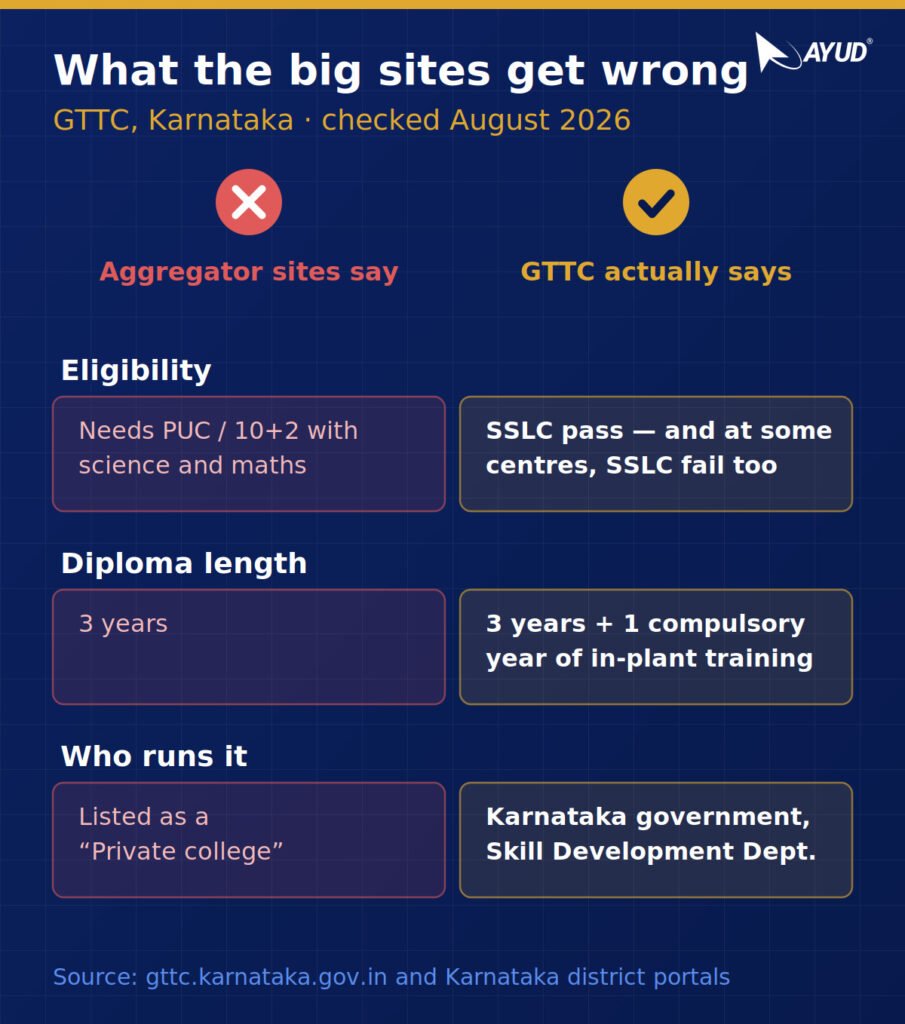
Applying to the tool room machinist course needs very little paperwork. Carry these to the centre: SSLC marks card, study certificate, caste and income certificates, a domicile or Karnataka study proof, passport photographs, and an Aadhaar copy. Take originals and two photocopy sets of each. Ask one question at the counter above all others: when does the next batch start, and is the seat list already closed?
Tool room machinist course fees and the stipend question
Short-term GTTC certificate fees are set centre by centre and are considerably lower than diploma fees. For reference, the GTTC diploma route costs roughly ₹19,250 in the first year, with a ₹500 application fee and a ₹3,000 refundable deposit against tools and instruments.
Now the honest part, because this is where families get misled. The tool room machinist course is a classroom-and-workshop certificate. It does not carry the fourth-year in-plant training that the GTTC diploma does, and it is that in-plant year — not the course itself — that pays a stipend. GTTC’s Dandeli centre records fourth-year diploma students deputed to industry on stipends of ₹11,000 to ₹17,500 per month. Those are diploma numbers. Do not walk into a certificate course expecting them.
What the tool room machinist course does buy you is a Karnataka government credential in twelve months instead of forty-eight, and a placement cell that talks to real tool rooms. If money is the binding constraint in your house this year, that trade is often the right one. Also check your SSP scholarship eligibility while you are at it — August to October is the Karnataka scholarship window, and it applies to many government skill programmes.
What does a tool room machinist actually earn in Karnataka?
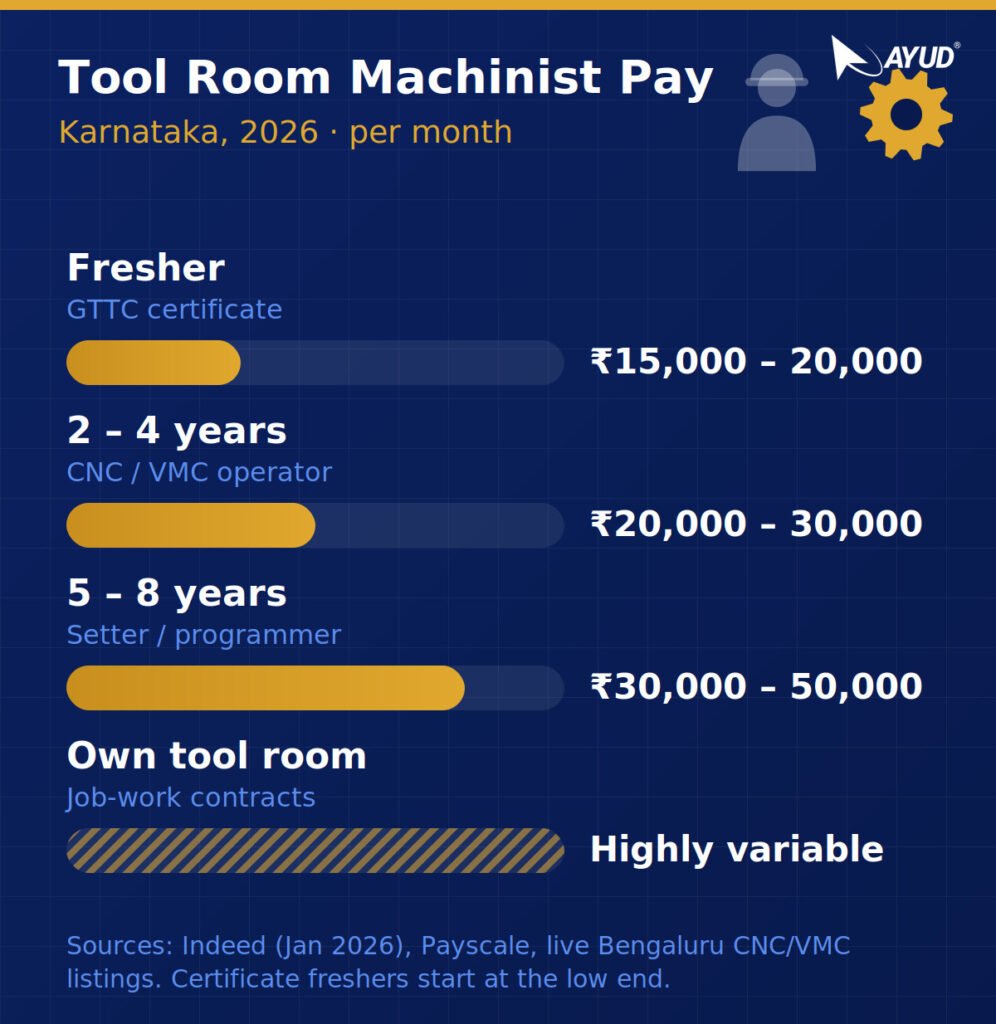
Entry pay for a machinist in Karnataka sits between ₹15,000 and ₹24,000 a month, and the honest midpoint for a fresher is nearer the bottom of that band. Indeed puts the average CNC operator salary in Bengaluru at ₹19,345 per month and the average CNC machinist salary across India at ₹21,253 per month as of January 2026. Payscale’s Bengaluru CNC operator median is ₹1.75 lakh a year. Live Bengaluru job listings for CNC and VMC operators cluster at ₹20,000 to ₹30,000, and tool room supervisory roles reach ₹35,000 to ₹50,000.
You will also find sites claiming ₹7.9 lakh a year for a Bengaluru CNC machinist. Ignore them. That figure comes from salary-model tools that extrapolate from American wage data, and it is not what any GTTC-trained fresher in Peenya is being offered this month.
| Stage | Typical monthly pay | What changes |
|---|---|---|
| Fresher, certificate | ₹15,000 – ₹20,000 | Conventional machines, supervised |
| 2–4 years | ₹20,000 – ₹30,000 | CNC/VMC operation, own setups |
| 5–8 years | ₹30,000 – ₹50,000 | Programming, setter, supervisor |
| Own tool room | Highly variable | Job-work contracts, machine EMI |
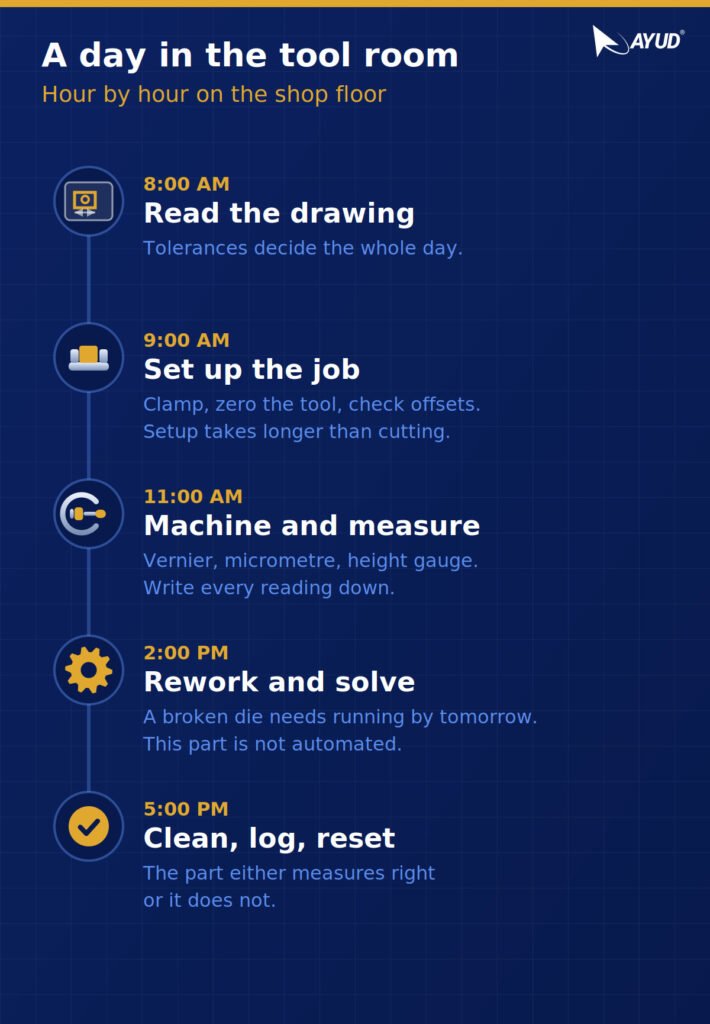
A day on the shop floor, hour by hour
Understanding the tool room machinist course means understanding the day it leads to, because the day is unusual and not everyone wants it.
The first shift starts around 8am. You do not begin by cutting metal. You begin by reading a drawing — a two-dimensional print of a three-dimensional object, with tolerances written beside each dimension, and your entire day depends on reading them correctly. Then setup: clamping the workpiece, zeroing the tool, checking the offsets. Setup takes longer than cutting. Beginners always get this backwards.
Mid-morning is the actual machining, and it is quieter than people expect. A tool room is not a production line. You may spend three hours making one component. Between cuts you measure — vernier, micrometre, height gauge, bore gauge, sometimes a coordinate measuring machine — and you write the readings down.
After lunch, the thing everyone underestimates: rework and problem-solving. A fixture is out by four hundredths of a millimetre. A surface finish is not holding. Someone from production walks in with a broken die and needs it running by tomorrow. This is the part of the job that cannot be automated, and it is the reason a good tool room machinist stays employable while machine operators get replaced.
By 5pm you have cleaned the machine, logged the job, and reset the tools. It is physical, it is precise, and the feedback is brutally honest — the part either measures right or it does not.
Is the tool room machinist course better than ITI Machinist?
Neither is strictly better. The tool room machinist course is a one-year GTTC certificate focused on precision tool room work with government placement support. ITI Machinist is a two-year NCVT trade certificate with wider national recognition and apprenticeship access. Choose GTTC for speed and tool room specialisation, ITI for portability and apprenticeship routes.
If you are weighing that decision seriously, read our full breakdown of polytechnic vs ITI first, and check whether an ITI admission in Karnataka 2026 seat is still available in your district before you commit to a certificate. Round-based counselling often leaves machinist trade seats open in mop-up that were full in round one.
Where this sits on the Ayud scale
We rate careers on three levels: Scarcity, Balanced and Overvalued. Precision machining sits in Scarcity — genuinely short of skilled people, particularly in aerospace and defence supply chains around Bengaluru, where component work is growing and experienced tool room hands are ageing out.
Here is the catch, and I say this to every parent who asks me about the tool room machinist course. Scarcity does not mean high starting pay. It means durable pay. Your first year will be ₹15,000-odd and it will feel like a mistake. Year five is where this career separates from the alternatives, and only if you keep learning — CNC programming, CAD/CAM, metrology. The people who stayed manual-only did not do well.
Frequently asked questions
Can I join the tool room machinist course if I failed SSLC?
At several GTTC centres, yes. GTTC has run this one-year course for SSLC passed and failed candidates from low-income unemployed backgrounds. Eligibility is set centre by centre, so confirm with your nearest GTTC before applying.
Is GTTC a government institution?
Yes. GTTC was established in Bengaluru in 1972 by the Government of Karnataka in collaboration with the Government of Denmark, and operates under the Department of Skill Development, Entrepreneurship and Livelihood. Sites listing it as private are wrong.
Does the tool room machinist course guarantee a job?
No course guarantees a job. GTTC provides placement assistance and its centres maintain industry links, but placement depends on your practical marks, your willingness to relocate within Karnataka, and shift-work availability.
Can I do a diploma after this certificate?
The certificate does not give diploma equivalence. Many students work for two or three years, then join the four-year GTTC Diploma in Tool and Die Making or a lateral-entry polytechnic route, funding it with their own earnings.
Is machining a safe career with AI and automation coming?
Automation replaces repetitive machine operation, not tool room problem-solving. The tool room machinist course trains you for the second kind of work. Making a one-off fixture, diagnosing a failing die, holding a micron tolerance on an unfamiliar material — these remain human work. Move toward setup, programming and inspection, not away from them.
What to do this week
If a seat did not come through this season, do not spend the year waiting for the next one. Call your nearest GTTC centre and ask about short-term batch dates. Ask about the tool room machinist course by name — front-desk staff will know it even when the website does not list it.
Not sure whether machining suits you at all? Take our free self-assessment at GoTestIt before you commit twelve months. If you would rather talk it through with someone who does this every week, book a Clarity Session and bring your marks card.
Register on Ayud Jobs & Get Hired Faster
Create your free profile, apply in one tap, and let recruiters find you. Your next opportunity is closer than you think.