
Skill Gap India 2026: Why Degrees Aren’t Enough
⏱ 9 min read
QUICK ANSWER
The skill gap India 2026 problem is not that we have too few graduates — it is that we have too few job-ready ones. Only 26 out of every 100 graduates aged 15–29 held a regular salaried job in 2025, and just 4 had a written contract, paid leave and social security together (Bloomberg analysis of PLFS unit-level data, reported July 2026). Graduate unemployment sits at 11.2% against a national rate of 3.1% (PLFS Annual Report 2025), while national employability has risen to 56.35% (India Skills Report 2026). In short: the degree still opens the door, but the skill decides whether you walk through it.
The skill gap India 2026 data tells a story no one wants to say out loud at a family function. India now enrols 4.50 crore students in higher education, with a Gross Enrolment Ratio of 30 — the highest ever recorded (AISHE 2023–24, released July 2026). We are producing degrees at record speed.
Register on Ayud Jobs & Get Hired Faster
Create your free profile, apply in one tap, and let recruiters find you. Your next opportunity is closer than you think.
And yet, according to the Periodic Labour Force Survey Annual Report 2025, a graduate in India is more than three times as likely to be unemployed as the national average. Someone with no formal literacy has an unemployment rate of 0.3%. A graduate has 11.2%.
That single line is the skill gap India 2026 story in one sentence. I sit with students and parents in Kalaburagi every week, and this is the conversation that has changed the most in two years. It used to be “which college?” Now it is “will this actually get him a job?”
Skill Gap India 2026: What the Data Actually Shows
Here is the skill gap India 2026 picture in six numbers, each from a named source with its year. Read this table before you read anyone’s opinion, including mine.
| Indicator | Latest figure | Source (year) |
|---|---|---|
| Graduates aged 15–29 in regular salaried jobs | 26 out of 100 | Bloomberg analysis of PLFS unit-level data (2026) |
| Graduates with contract + paid leave + social security | 4 out of 100 | Bloomberg analysis of PLFS unit-level data (2026) |
| Graduate unemployment rate vs national rate | 11.2% vs 3.1% | PLFS Annual Report (2025) |
| National employability of Indian youth | 56.35%, up from 54.81% | India Skills Report (2026) |
| Workers aged 15–59 with formal vocational training | About 4.1% | PLFS vocational training data (2023–24) |
| Core job skills expected to change by 2030 | 39% | WEF Future of Jobs Report (2025) |
Notice that the skill gap India 2026 figures come from four separate sources that were never designed to agree with each other — a government survey, an employability test, a global employer survey and a news analysis of raw microdata. They all point the same way. That is what makes this a structural problem and not a bad year.
Why a Degree Alone Stopped Working
The skill gap India 2026 debate usually blames students. The data blames the design. Enrolment grew 31.5% in a decade, from 3.42 crore in 2014–15 to 4.50 crore in 2023–24 (AISHE). Formal vocational training crept from about 2% to about 4.1% in roughly the same period. We scaled the certificate and skipped the workshop.
The result shows up in the Economic Survey 2024–25, which estimated that over 53% of graduates and 36% of postgraduates are underemployed — working in jobs below their qualification. They are not idle. They are misplaced.
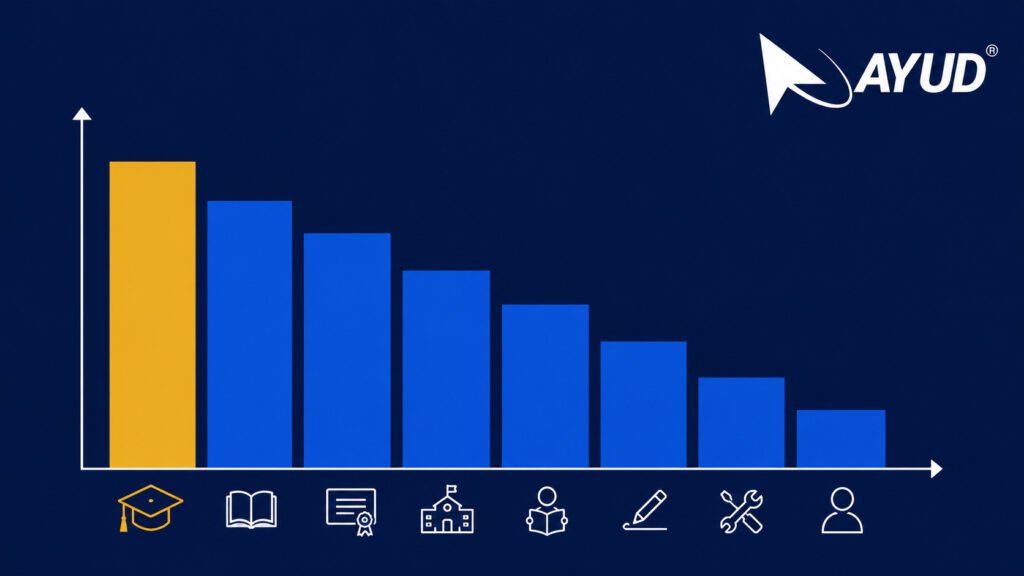
The education paradox nobody explains to parents
This inversion is the hard centre of the skill gap India 2026 problem: in India, more education currently correlates with more unemployment, not less.
| Highest education level | Unemployment rate, 2025 |
|---|---|
| Not literate | 0.3% |
| All persons aged 15+ | 3.1% |
| Secondary and above | 6.5% |
| Postgraduate | 10.0% |
| Graduate | 11.2% |
| Graduate, rural | 11.8% |
Source: Periodic Labour Force Survey Annual Report 2025, MoSPI.
Here is the catch, and it matters: this table does not mean education is useless. A person with no literacy is “employed” because they cannot afford one day of unemployment — they take whatever daily wage exists. A graduate can wait, and waits for a job that matches the degree. The paradox is a measure of expectation meeting supply, not of degrees being worthless. But when a graduate waits two years for a job that never arrives, that is what the skill gap India 2026 numbers are measuring.
What Employers Are Actually Buying in 2026
So what are employers actually buying in the skill gap India 2026 market? The India Skills Report 2026, built on responses from over 1,00,000 candidates through the Global Employability Test plus industry input across seven sectors, names them plainly: AI, data analytics, cloud computing and cybersecurity are the most in-demand skills. Technology, BFSI, manufacturing, renewable energy and healthcare are the leading hiring sectors. Karnataka ranks among the top three states for employability, alongside Uttar Pradesh and Maharashtra.
Two more numbers change how you should plan. The gig and freelance workforce is projected to reach 23.5 million by 2030, with project-based hiring up 38% in the past year. And the WEF expects 39% of core skills to change by 2030 — down from 44% in 2023, but still meaning two of every five things you learn today get rewritten before you turn 30. Employers are hiring for demonstrated capability on shorter contracts, which is why the skill gap India 2026 conversation has shifted from degrees to proof.
Is the Skill Gap India 2026 Problem Caused by AI?
No. AI is accelerating the skill gap India 2026, not creating it. The gap existed when only 4.1% of workers had formal vocational training and 53% of graduates were underemployed — both true before generative AI reached Indian offices. What AI changed is the deadline. The section below shows which side of that deadline each career now sits on.
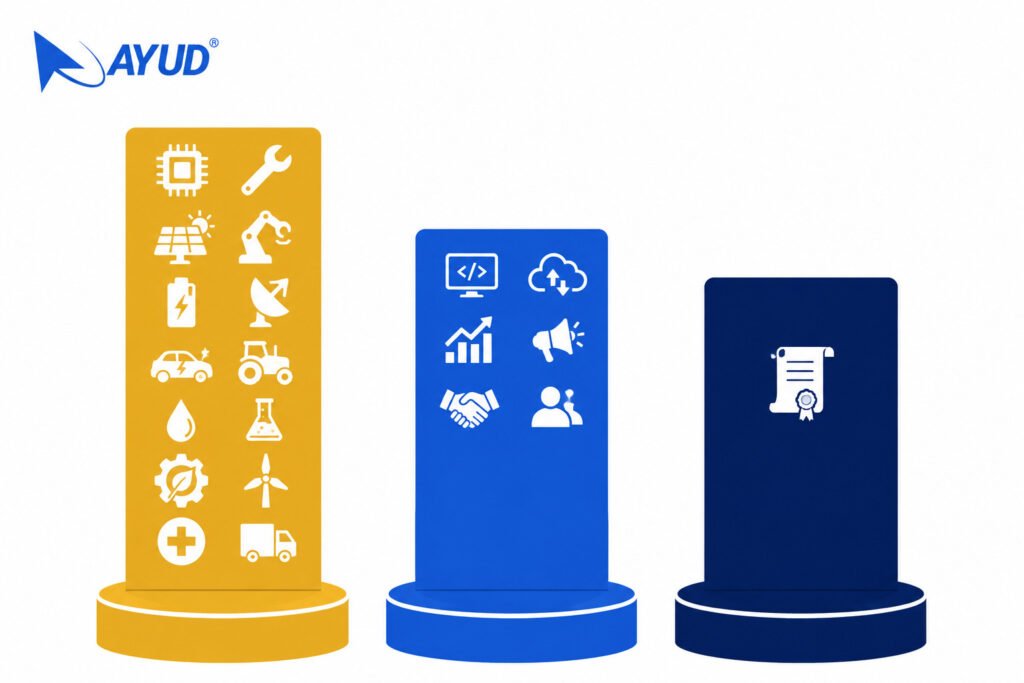
The Ayud Lens: Scarcity, Balanced, Overvalued
I sort every course through three buckets before I discuss the skill gap India 2026 with a family. It is blunt, and parents usually thank me for it later.
| Bucket | What it means | Examples in 2026 | The catch |
|---|---|---|---|
| Scarcity | Demand is running ahead of trained supply | Cybersecurity, data and AI operations, cloud support, CNC and mechatronics technicians, solar and EV technicians, medical lab technology | Employers want a portfolio or apprenticeship record. A certificate with no project behind it gets filtered out. |
| Balanced | Steady demand, salary rises with experience not credentials | Nursing, GST and accounts compliance, field sales, logistics and supply chain, teaching, hospitality | Entry is easy, exit is hard. Growth needs a deliberate specialisation by year three. |
| Overvalued | Supply has outrun demand at the entry level | A general BA, B.Com or BBA with no added skill; generic “computer course” certificates; unaccredited online diplomas | The degree is fine. The degree alone is what fails. Pair it with one scarcity skill and it works again. |
Note what is not in the overvalued column: trade and technical training. A well-chosen ITI admission 2026 Karnataka route or a diploma often reaches paid work faster than a general degree — PLFS 2025 found 82.7% of men holding a diploma or certificate were in the workforce, against 79.1% of graduates. If you are weighing the diploma-versus-degree question after a state entrance exam, the DCET 2026 Karnataka counselling and seat matrix guide covers the lateral-entry route in detail.
One Real Story From My Desk
Rohit finished his B.Com in Kalaburagi in 2024 with 71%. For fourteen months he applied to banks, wrote three competitive exams and got nothing. His father asked me what went wrong with the degree. Nothing went wrong with the degree — it just said the same thing as forty thousand other applications that year.
We picked one scarcity skill next to it: GST filing plus Tally plus real spreadsheet work, about five months, evenings. He then did unpaid books for two small traders in his own market so he had something to show. He is now on ₹18,000 a month with a distribution firm, and handles the returns for two branches. Rohit’s year is the skill gap India 2026 in one household — the degree was never the problem, the missing second half was.
How to Close Your Own Gap in Nine Months
You cannot fix the skill gap India 2026 nationally. You can close yours in about nine months, and here is the honest sequence I give students.
- Pick one scarcity skill, not three. Three half-learned skills lose to one demonstrable skill every single time.
- Chase the apprenticeship, not just the certificate. Under the Apprentices Act, establishments with 30 or more employees must engage apprentices between 2.5% and 15% of their workforce, with stipends typically between ₹5,000 and ₹9,000 a month. Karnataka already runs one of the largest apprentice bases in the country. Most students never apply because nobody told them it exists.
- Build proof, not a resume line. Three real projects, a GitHub link, a client’s WhatsApp testimonial, a machine you can operate on video. Proof beats paper.
- Add AI fluency to whatever you chose. Not a “prompt engineering” course — just competent daily use of AI tools inside your own trade.
- Re-check every 18 months. With 39% of core skills changing by 2030, a skill audit is not a one-time event.
The catch: months four to six are when almost everyone quits, because the certificate is finished and the job has not arrived yet. That gap is normal. Push through it with project work, not more courses. For the full report-by-report view, see our India Skills Report 2026 breakdown.
Not sure which bucket your course sits in? Take the free GoTestIt self-assessment and get your scarcity-skill shortlist in about 12 minutes.
Frequently Asked Questions
What is the skill gap India 2026 in simple words?
It is the distance between what colleges certify and what employers will pay for. In 2026 that distance shows up as 56.35% employability (India Skills Report 2026) and 11.2% graduate unemployment (PLFS 2025) existing at the same time.
Is a degree still worth it in 2026?
Yes, as a base — not as a finished product. Graduates still access a wider ceiling of roles. The failure happens when the degree is the only asset on the resume.
Which skills are most in demand in India right now?
AI, data analytics, cloud computing and cybersecurity lead the India Skills Report 2026 list, with technology, BFSI, manufacturing, renewable energy and healthcare hiring hardest.
Is a diploma or ITI better than a degree for jobs?
Faster to first income, often yes. PLFS 2025 recorded 82.7% workforce participation among men with a diploma or certificate versus 79.1% among graduates. Long-term ceiling still favours the degree-plus-skill combination.
Will AI make my course useless?
Unlikely to make it useless, likely to change it. The WEF expects 39% of core skills to shift by 2030 — that is 61% staying stable. Plan for a rewrite, not a replacement.
The Bottom Line
The skill gap India 2026 is not a reason to skip college. It is a reason to stop treating the degree as the finish line. Twenty-six out of a hundred is not a headline — it is a warning that the second half of the plan is missing for three-quarters of Indian graduates.
Your next step: Book a Clarity Session and we will map your degree against the scarcity list in 30 minutes — or register free on Ayud and get the roadmap inside Career LAB. Doubts in between? Ask Ayud, or get the Ayud app on Play Store.
Register on Ayud Jobs & Get Hired Faster
Create your free profile, apply in one tap, and let recruiters find you. Your next opportunity is closer than you think.