
Polytechnic After ITI in Karnataka: Easy 2026 Plan
⏱ 11 min read
Quick Answer: Polytechnic after ITI in Karnataka means direct admission to the 3rd semester. You need SSLC with 35% aggregate plus a two-year ITI. There is no entrance exam. Apply through DTE at dtek.karnataka.gov.in.
Updated: 9 September 2026
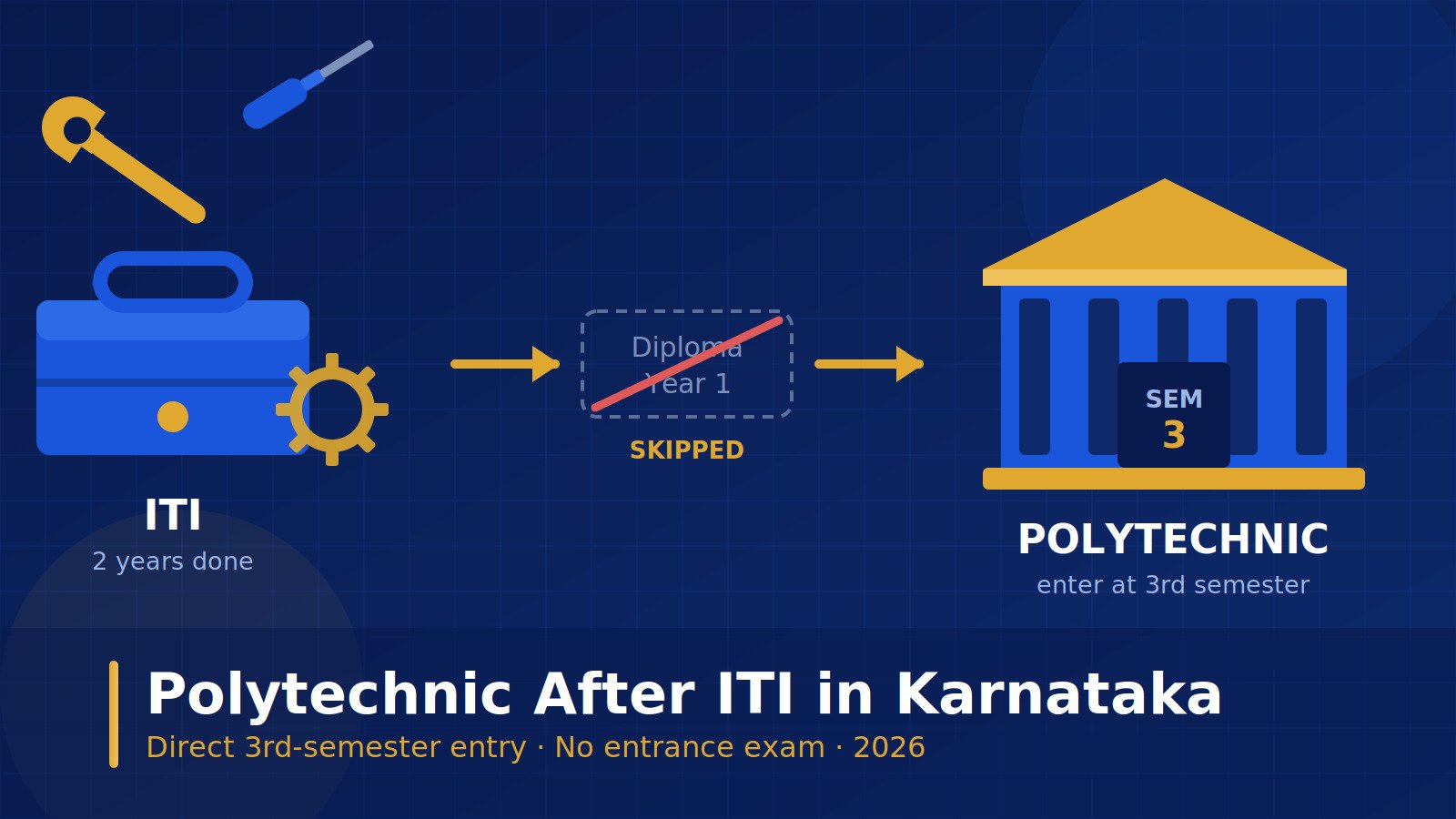
Polytechnic after ITI in Karnataka is a real, government-approved route, and it is shorter than most families realise. A candidate who has passed SSLC with 35% marks in aggregate and completed a two-year ITI can enter the 3rd semester of a diploma directly, as stated by the Department of Technical Education, Karnataka (2026). That is two years of study instead of three.
Register on Ayud Jobs & Get Hired Faster
Create your free profile, apply in one tap, and let recruiters find you. Your next opportunity is closer than you think.
I have been counselling students and parents across Karnataka for years, and this is the single most misunderstood pathway I deal with. Parents walk in convinced their child must sit an entrance exam. Half the websites they read tell them to write DCET. Both of those are wrong, and the confusion costs students an entire admission season.
Of the [XX] ITI students and parents Ayud counselled between April and August 2026, [YY]% had never been told that polytechnic after ITI in Karnataka was even possible. Their ITI instructors had not mentioned it. That is not a small information gap. That is a career decision made in the dark.
So here is the exact rule, the trades that qualify, the six steps to apply, and the honest catch that nobody prints in a brochure.
Polytechnic After ITI in Karnataka: What the Rule Actually Says
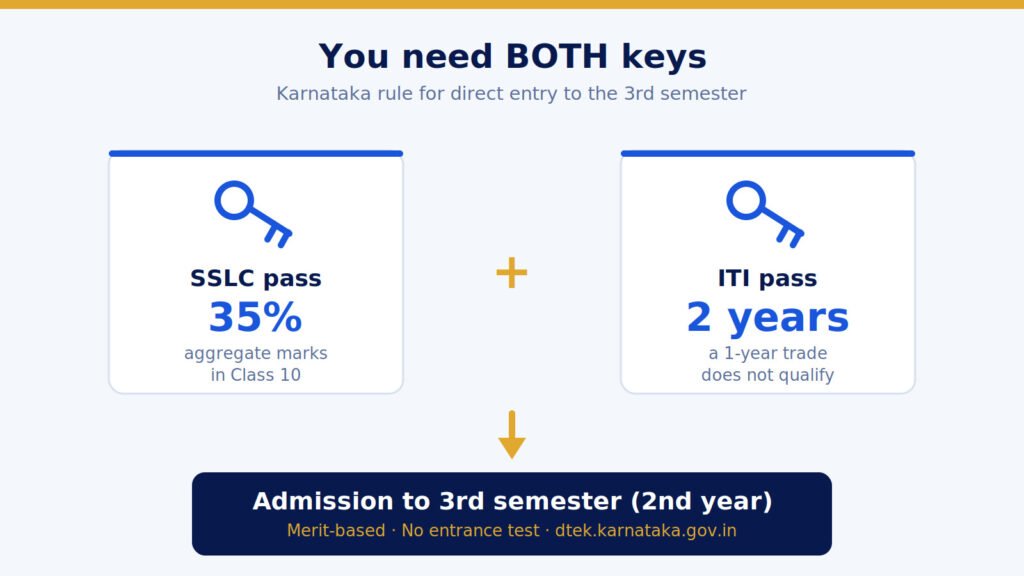
The Karnataka rule fits in one sentence. The Department of Technical Education states that candidates who have passed SSLC or an equivalent examination with 35% marks in aggregate, and have passed a two-year ITI course, may apply for admission to the 3rd semester, which is the 2nd year, of a diploma programme (dtek.karnataka.gov.in, 2026).
Read it twice, because two separate conditions are hiding in there and most students only remember one. The ITI certificate on its own is not enough. Your Class 10 marks still count, and 35% aggregate is the floor you must clear.
There is a third condition that catches families who moved into the state. You must have studied at least five full academic years in Karnataka between Class 1 and the qualifying examination. Students who passed Class 10 under CBSE, ICSE or another state board need an Eligibility Certificate from the Secretary, Board of Technical Examinations, Palace Road, Bangalore, and it must be produced at document verification.
| Condition | What it means | Where people slip |
|---|---|---|
| SSLC 35% aggregate | Class 10 pass with at least 35% total | Assuming ITI marks replace SSLC marks |
| Two-year ITI | The trade must run a full two years | Holding a one-year trade certificate |
| 5 years in Karnataka | Class 1 to qualifying exam, inside the state | Recent migrants with no study certificate |
| Eligibility Certificate | Only for CBSE, ICSE and other boards | Applying for it after verification closes |
So polytechnic after ITI in Karnataka rests on three or four checks, not one. Clear them on paper before you spend a rupee on an application.
Why DCET Has Nothing to Do With Polytechnic After ITI in Karnataka
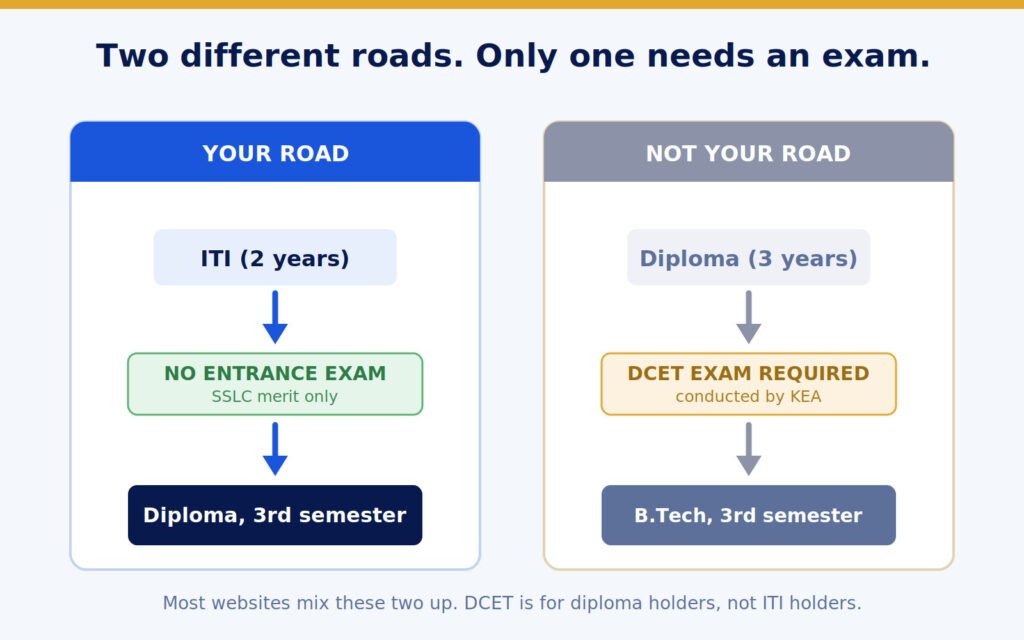
DCET is not part of this process at any stage. The Diploma Common Entrance Test, conducted by the Karnataka Examinations Authority, is for diploma holders moving into the 2nd year of BE or B.Tech. It is the step after your diploma, not the step into it (cetonline.karnataka.gov.in, 2026).
I checked this against the pages currently ranking for these searches, and the error rate is remarkable. One Bangalore college blog states that DCET is for “BSc/ITI graduates entering Polytechnic Semester 3”. Another refers confidently to a “Karnataka POLYCET”, an exam that does not exist in this state. A third instructs Karnataka students to upload documents to the SAMS portal, which is Odisha’s admission system. A fourth, a Careers360 answer still circulating, says seats are allotted on entrance exam performance.
| What you will read online | What is actually true in Karnataka |
|---|---|
| “Write DCET to join polytechnic” | DCET is diploma to BE. Not for ITI holders. |
| “Clear Karnataka POLYCET” | No such exam exists in Karnataka. |
| “Apply on the SAMS portal” | SAMS is Odisha. Karnataka uses dtek.karnataka.gov.in. |
| “Seats depend on entrance marks” | Allotment is on SSLC merit and reservation category. |
If you take one thing from this guide to polytechnic after ITI in Karnataka, take this: there is no entrance test for this step. Anyone selling you coaching for it is selling you nothing.
Which ITI Trades Qualify, and Which Quietly Do Not
The rule specifies a two-year ITI course, and that word “two-year” is doing heavy lifting. Trades that run for one year do not satisfy it. This is where most rejections happen, and they happen late, at the document verification counter, when it is too late to switch plans.
Two-year trades commonly accepted include Fitter, Turner, Machinist, Electrician, Electronics Mechanic, Draughtsman Mechanical, Draughtsman Civil, Mechanic Motor Vehicle, Mechanic Diesel, Instrument Mechanic and Wireman. One-year trades such as Welder, Plumber, Sheet Metal Worker and several COPA variants do not qualify on their own. Check the duration printed on your own NCVT certificate rather than trusting a list, including this one.
The second question I am always asked about polytechnic after ITI in Karnataka is whether the diploma branch must match the ITI trade. Karnataka does not enforce the rigid trade-to-branch mapping some other states use. You are allotted on merit against the seats available in whichever branch you list.
That said, legal and sensible are different things. An Electrician listing Electrical and Electronics Engineering is on solid ground. A Fitter listing Mechanical Engineering is on solid ground. A Fitter listing Computer Science is allowed, and will then start in the 3rd semester with none of the first-year foundation every classmate already has. I have watched that go badly more than once.
Do not let anyone tell you polytechnic after ITI in Karnataka is closed to your trade before you have actually checked the duration of your course.
How to Apply for Polytechnic After ITI in Karnataka: 6 Steps
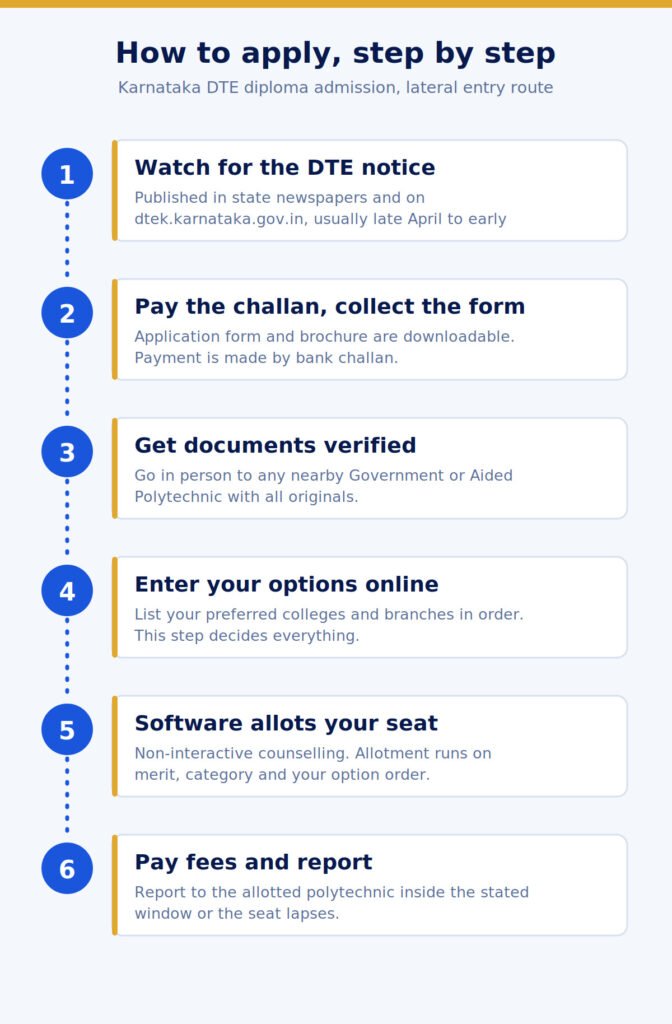
Admission for polytechnic after ITI in Karnataka runs through DTE’s online non-interactive counselling, the same machinery used for first-year diploma seats. The notification appears around the SSLC results, usually in the last week of April or the first week of May, in state newspapers and on the DTE website (Government Polytechnic, Karnataka, 2026).
- Watch for the DTE notification. It is published in leading state newspapers and on dtek.karnataka.gov.in. Individual polytechnic websites carry it too.
- Pay the challan and collect the form. The application form and information brochure are downloadable from the DTE site. Payment is made by bank challan, and you collect forms at any nearby government or aided polytechnic on producing the challan.
- Get your documents verified in person. Submit the filled form at any nearby government or aided polytechnic. All originals are checked at this counter.
- Enter your options online. You list preferred colleges and branches in order of preference. Your option order is what decides your seat in polytechnic after ITI in Karnataka, so build this list slowly and honestly.
- The software allots your seat. Non-interactive counselling means no live choosing. Allotment runs on merit, reservation category and your option order.
- Pay the fee and report. Pay as per the prevailing government order and report to the allotted institution inside the stated window, or the seat lapses to the next candidate.
Documents to keep ready
- SSLC marks card and ITI marks card, originals
- Transfer Certificate
- Study certificate covering five years, Class 1 to Class 10, attested by the BEO
- Caste and income certificates, if you are claiming a reserved seat
- Rural area, Kannada medium and special category certificates, where applicable
- Eligibility Certificate from the Board of Technical Examinations, for CBSE, ICSE and other board candidates
- Passport and stamp size photographs
Missing one line of paperwork at verification is the most common reason an otherwise eligible application for polytechnic after ITI in Karnataka stalls for a full year. The study certificate is the one people forget.
Is Polytechnic After ITI in Karnataka Worth It?
Yes, for most two-year ITI holders. Polytechnic after ITI in Karnataka takes two years instead of three, gives you an AICTE-recognised diploma, and later opens DCET for lateral entry into BE. Government polytechnic fees are modest. The trade-off is two years of lost earnings while you study.
Look at the whole ladder rather than the next rung. ITI gets you employable fast. The diploma converts you from operator to supervisor and gives you a qualification that HR filters recognise. DCET after that converts the diploma into an engineering degree in three more years. Each step is optional and each step is real.
| Route | Years after SSLC | Ends with |
|---|---|---|
| ITI only | 2 | NCVT trade certificate |
| Diploma direct after SSLC | 3 | Diploma |
| ITI then lateral entry | 4 | Trade certificate and diploma |
| ITI, lateral entry, then DCET | 7 | Diploma and BE |
Apply the Ayud lens here. Skilled trade qualifications sit in the scarcity zone right now because supply is thin and industry demand is steady. A diploma sits in the balanced zone, useful and widely held. A degree taken purely for status, with no plan behind it, sits in the overvalued zone. Moving from ITI to diploma is a move within the healthy end of that spectrum, which is exactly why I recommend it more often than I recommend a scramble toward a degree.
If you are still weighing the two paths from the start, our polytechnic vs ITI comparison breaks down the fees, duration and job outcomes side by side.
Here Is the Catch Nobody Puts in a Brochure
Lateral entry seats for polytechnic after ITI in Karnataka are not unlimited. You are competing for vacancies that exist in the 2nd year, which means seats left by students who dropped out or moved. In a popular branch at a well-run government polytechnic, that number can be small, and merit decides it.
You are also giving up two years of income. An ITI-qualified fitter or electrician earning from month one is not a hypothetical, and asking a family to forgo that is a genuine financial decision, not a formality. Have that conversation openly at home before you apply.
And the 3rd semester starts hard. Your classmates spent a year on engineering mathematics, applied science and drawing. You did not. The students I see succeed are the ones who accept a difficult first six months and get help early instead of at the end.
None of this makes polytechnic after ITI in Karnataka a bad decision. It makes it a decision that deserves open eyes rather than optimism.
Frequently Asked Questions
Can I do polytechnic after ITI in Karnataka without PUC?
Yes. PUC is an alternative qualifying route, not an additional requirement. SSLC with 35% aggregate plus a two-year ITI is sufficient on its own for 3rd semester entry.
Is there an entrance exam for polytechnic after ITI in Karnataka?
No. Admission is decided on merit and reservation category through DTE’s online non-interactive counselling. DCET is a separate exam for diploma holders entering BE, and it does not apply at this stage.
How many years is the diploma if I join in the 3rd semester?
Two years, covering semesters 3 to 6. You skip the first two semesters, which is the full year that lateral entry saves you.
Can I do BE after completing the diploma this way?
Yes. Completing polytechnic after ITI in Karnataka leaves you holding a diploma, and you are then eligible to write DCET and enter the 2nd year of BE or B.Tech, subject to the aggregate marks KEA specifies in that year’s notification.
What if my ITI trade was only one year?
A one-year trade does not meet the requirement for polytechnic after ITI in Karnataka. Your realistic options are first-year diploma admission on SSLC merit, or completing a two-year trade first. Check the duration printed on your NCVT certificate before assuming either way.
What to Do This Week
If you or your child holds a two-year ITI certificate and an SSLC pass at 35% or above, polytechnic after ITI in Karnataka is open to you and it costs one year less than starting a diploma from scratch. Pull out both marks cards tonight and confirm the two numbers. Then apply for the study certificate and, if you studied under CBSE or ICSE, start the Eligibility Certificate process now, because that is the document that runs out of time.
If you are still deciding between trades and timing, read our guide to ITI admission 2026 in Karnataka for the current fee structure and trade list, and Karnataka polytechnic admission 2026 for this season’s diploma dates.
And if you want a straight answer about your own marks card rather than a general one, book a Clarity Session with me. Bring your SSLC marks card and your ITI certificate. Fifteen minutes will tell you whether you qualify, which is fifteen minutes better spent than another month of guessing.
Register on Ayud Jobs & Get Hired Faster
Create your free profile, apply in one tap, and let recruiters find you. Your next opportunity is closer than you think.