
India Skills Report 2026: 44% Aren’t Job-Ready
⏱ 10 min read
Quick Answer
The India Skills Report 2026 puts national employability at 56.35%, up from 54.81% in 2025 (ETS with CII, AICTE, AIU and Taggd, released November 2025). Women crossed men for the first time, at 54% against 51.5%. Computer science graduates score highest at 80%. Uttar Pradesh, Maharashtra and Karnataka are the top three states. The number that matters most to you, though, is the one nobody prints: 43.65% of graduates are still not job-ready.
The India Skills Report 2026 says 56.35% of India’s youth are employable, and every headline you have read called that good news. It is good news. But I sit with students and parents in Kalaburagi every week, and when I show them that same number written the other way round, the room goes quiet.
Register on Ayud Jobs & Get Hired Faster
Create your free profile, apply in one tap, and let recruiters find you. Your next opportunity is closer than you think.
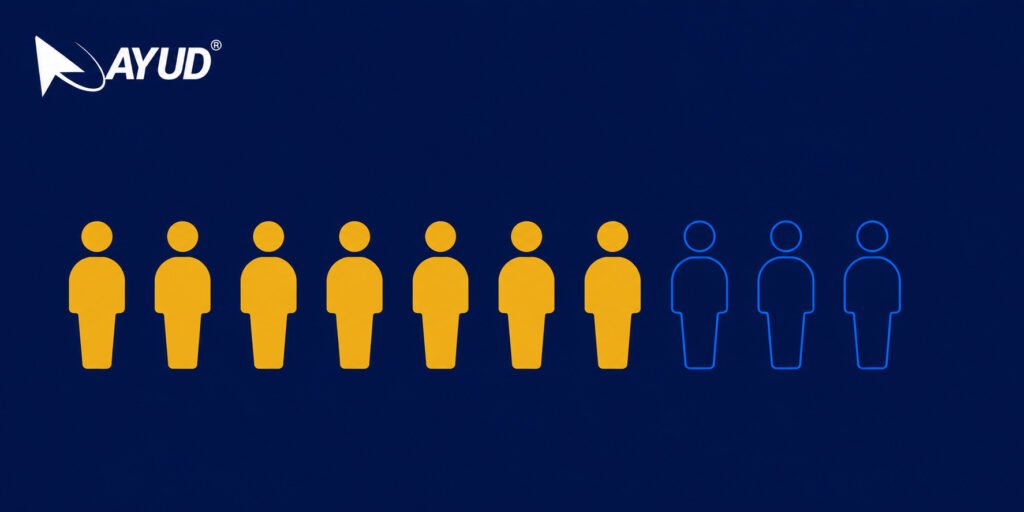
Fifty-six point three five percent employable means 43.65% are not. That is roughly four out of every ten graduates walking out of a college gate without the skills an employer will pay for. That gap, not the celebration, is exactly what the India Skills Report 2026 is really telling you.
So let me do what the news reports did not. Let me take this data and turn it into a decision you can actually make this admission season.
India Skills Report 2026: What the Numbers Actually Say
First, the credentials, because data is only worth as much as its source. The India Skills Report 2026 is the 13th edition of an annual study run by ETS (the global testing body behind GRE and TOEFL) in partnership with the Confederation of Indian Industry, AICTE, the Association of Indian Universities and hiring platform Taggd. It assessed more than 1,00,000 candidates through the Global Employability Test and surveyed 1,000 employers across seven industries, covering 20 states and three union territories.
That is a serious sample. Here are the headline figures from the India Skills Report 2026, released in November 2025.
| What was measured | 2026 figure | What it means for you |
|---|---|---|
| National employability | 56.35% (was 54.81%) | Improving, but 44% still fall short |
| Women vs men | 54% vs 51.5% | Women ahead for the first time |
| Fresher hiring intent, FY27 | 40% (was 29%) | Companies plan to hire more freshers |
| India’s share of global AI talent | 16%, 1.25 million by 2027 | AI skills are not optional any more |
| Employees using generative AI | Over 90% | Your first boss already uses it daily |
| Gig and freelance workforce | 23.5 million by 2030 | A real career path, not a side hustle |
| Top hiring sectors | Tech, BFSI, manufacturing, renewable energy, healthcare | Aim your skill at one of these five |
The 44% Nobody Puts in the Headline
Every summary of this study leads with the rise. I want to sit with the remainder for a minute, because the India Skills Report 2026 does not say the other 44% are lazy or unintelligent. It says they are unemployable against what industry currently needs, which is a completely different problem with a completely different fix.
Employers in the study were blunt about why. Curricula lag behind technology. Soft skills such as communication, teamwork and problem-solving stay weak. Digital access is uneven between a metro and a taluk. None of that is the student’s fault, and all of it is the student’s problem.
Here is the honest catch nobody tells you at an admission counter: your college will not close this gap for you. The degree gets you the interview. What you built outside the syllabus gets you the offer. I have written separately on why India still has a skills shortage despite producing millions of graduates every year, and the root cause has not changed.
Which Courses Actually Score Highest?
This is the question parents ask me first, and the study answers it directly. The India Skills Report 2026 ranks computer science graduates highest at 80% employability, with IT engineers just behind at 78%, driven by demand in AI, data analytics, automation, cloud and cybersecurity.
But read that carefully before you rush your child into a CS seat. Those graduates do not score high because of the degree name. They score high because their coursework happens to overlap with the five skills employers are short of. A mechanical diploma holder who learns industrial automation and CAD is chasing the same premium from a different door.
The skills in shortage right now, according to the same study, are AI and machine learning, data analytics, cloud computing, cybersecurity, and digital fluency paired with critical thinking. Notice that only one of those five is a degree. The rest are certifications you can stack on top of whatever you are already studying.

Where Karnataka Stands, and Why It Matters Locally
Now the part written for us. The India Skills Report 2026 places Karnataka third nationally for employability, behind Uttar Pradesh and Maharashtra, with Kerala at fourth. Bengaluru’s technology base does most of that lifting.
There is a second figure worth staring at. On digital fluency and critical thinking, the same study puts Maharashtra at 68.23% and Karnataka at 54.83%. Read that again. Karnataka ranks third in the country for overall employability while sitting nearly fourteen points behind Maharashtra on the exact skills that decide who gets hired in an AI-heavy market. That is what the India Skills Report 2026 shows about digital fluency, and it is a warning, not a trophy.
For a student in Kalaburagi, Bidar, Raichur or Ballari, the practical translation is simple: you are competing inside a state whose average is propped up by one city. Your edge has to be built deliberately. If you are choosing a technical route this year, start with ITI admission in Karnataka for 2026 or, for the diploma-to-degree path, DCET 2026 counselling and seat allotment, and then layer a certification on top.

What Does the India Skills Report 2026 Mean for a Student Choosing a Course?
The India Skills Report 2026 tells students one thing clearly: employers now hire for proven skills, not just degrees. With employability at 56.35%, nearly 44 out of every 100 graduates are still not job-ready. Your course matters less than the certified, demonstrable skill you build alongside it.
That sounds simple. Applying it is where families get stuck, because it means the question changes from “which course has the best reputation” to “which course plus which skill makes me hard to replace in 2030.” Those are not the same question, and they very often have different answers.
The Scarcity, Balanced and Overvalued Map
At Ayud we read the India Skills Report 2026 through this filter, because raw employability percentages hide the thing that actually sets your salary: how many people can do what you can do.
| Category | Examples from the 2026 data | Your move |
|---|---|---|
| Scarcity Demand far above supply |
AI and ML, cybersecurity, cloud, data analytics, renewable energy technicians | Enter here even if the course sounds unfamiliar. Pay premium is real. |
| Balanced Steady demand, steady supply |
Core manufacturing, BFSI operations, healthcare support, civil and mechanical | Safe, but only with a scarcity skill stacked on top. |
| Overvalued Supply far above demand |
Generic degrees with no applied component or certification | Avoid as a standalone plan. This is where most of the 44% sit. |
I have broken this framework down in full in the scarcity–balanced–overvalued career map, including how to test which bucket a specific course falls into before you pay the first fee instalment.

One Student, One Decision, One Year
Let me make this real. Two years ago a boy I will call Basavaraj came to our office in Kalaburagi with a mechanical diploma and no offers after eight months. His family had spent seriously on that diploma. He was ready to sit for any government exam that would take him, purely out of exhaustion, and this was long before he had ever heard of the India Skills Report 2026.
We did not tell him to abandon mechanical. We told him to stack. He took a six-month industrial automation and PLC certification while continuing to apply. Eleven months later he was placed with a manufacturing firm on the Hyderabad road at a starting package his classmates with the same diploma did not get.
Nothing about his degree changed. What changed was that he moved from the overvalued column into the scarcity column, using one certificate and eleven months. That is the entire lesson of this year’s data compressed into one boy’s story.
What To Actually Do in the Next 90 Days
Reports are useless until they become behaviour. So here is how to turn the India Skills Report 2026 into four things you do before this admission cycle closes.
- Pick your sector first, course second. Choose one of the five hiring leaders: technology, BFSI, manufacturing, renewable energy or healthcare. Then work backwards to the course that feeds it.
- Attach one scarcity skill to your course on day one. Not in the final year. Day one. AI fundamentals, data analytics, cloud or cybersecurity, depending on your stream.
- Get comfortable with AI tools now. Over 90% of employees already use them and 70% of IT firms use AI in hiring itself. Being fluent is now baseline, not an advantage.
- Build proof, not just certificates. Two small projects, a portfolio link, one internship. Employers in the study said they want demonstrated capability, and a certificate alone is not demonstration.
If you are not sure which sector fits your actual aptitude rather than your family’s assumption, start with a structured self-assessment instead of guessing. Our GoTestIt assessment is free and takes about twenty minutes.
Frequently Asked Questions
Is the India Skills Report 2026 reliable?
Yes. It is produced by ETS with CII, AICTE, AIU and Taggd, based on over 1,00,000 candidate assessments through the Global Employability Test plus responses from 1,000 employers across seven sectors and 23 states and union territories. It is the 13th annual edition, so the year-on-year trend is consistent and comparable.
What is India’s employability rate in 2026?
56.35%, up from 54.81% in 2025 and 46.2% in 2022. That is close to a ten percentage point improvement in four years, but it still leaves 43.65% of assessed candidates rated as not job-ready.
Which degree has the highest employability in India right now?
Computer science leads at 80%, with IT engineering at 78%. The advantage comes from overlap with in-demand skills such as AI, data analytics, cloud and cybersecurity, not from the degree title itself, so those skills can be added to other streams too.
Does the India Skills Report 2026 cover diploma and ITI students?
The study assesses candidates across education streams, and its recommendations explicitly call for strengthening ITI, polytechnic and NSDC skilling aligned to local industry. Manufacturing and renewable energy, both diploma and ITI-heavy sectors, are among the five leading hiring sectors this year.
Are degrees becoming less important than skills in India?
The direction is clear. The study records a shift toward skills-first hiring, with micro-credentials, stackable certificates and experiential learning gaining ground over degree-only recruitment. A degree still opens the door. It no longer closes the deal on its own.
The One Line Worth Remembering
The India Skills Report 2026 is not a scoreboard for the country. It is a mirror for the individual. Employability rose to 56.35% because a slice of students did something extra, and it stalled at 43.65% because a larger slice waited for their college to do it for them.
You get to choose which side of that number you stand on, and you generally get about twelve months to choose it. Sources: Careers360 and Deccan Chronicle, November 2025.
Not sure which side of 56.35% you are on?
Book a 40-minute Clarity Session with an Ayud career expert. We will map your current stream against the scarcity, balanced and overvalued columns and tell you exactly which one skill to add next. Book your Clarity Session here.
Register on Ayud Jobs & Get Hired Faster
Create your free profile, apply in one tap, and let recruiters find you. Your next opportunity is closer than you think.