
Which Career Is Right for My Child? (2026 Guide)
⏱ 6 min read
Last month, a father in Kalaburagi sat across from me, visibly tense. His daughter had scored well in her board exams. Relatives were already pushing engineering. But she loved sketching and talking to people. “Sir,” he asked, “how do I know which career actually suits her?”
I hear this question almost every week. And honestly, it’s a good question to ask. Because choosing wrong costs years, money, and a child’s confidence.
So let me share a simple, practical method—the same one I use with families. No jargon. No guesswork. Just clarity.
Register on Ayud Jobs & Get Hired Faster
Create your free profile, apply in one tap, and let recruiters find you. Your next opportunity is closer than you think.

Why Career Confusion Feels So Heavy for Parents
You want the best for your child. That’s the whole problem. The pressure feels enormous because the stakes feel permanent.
But here’s a truth most people miss: a career choice is a direction, not a life sentence. You can course-correct. Still, starting in the right direction saves enormous effort later.
In India, the cost of getting it wrong is real. Industry reports have repeatedly flagged that a large share of engineering graduates struggle with employability, partly because many never wanted that path in the first place. They followed pressure, not fit.
So the goal isn’t to predict the future perfectly. The goal is to match your child to work they can grow in.
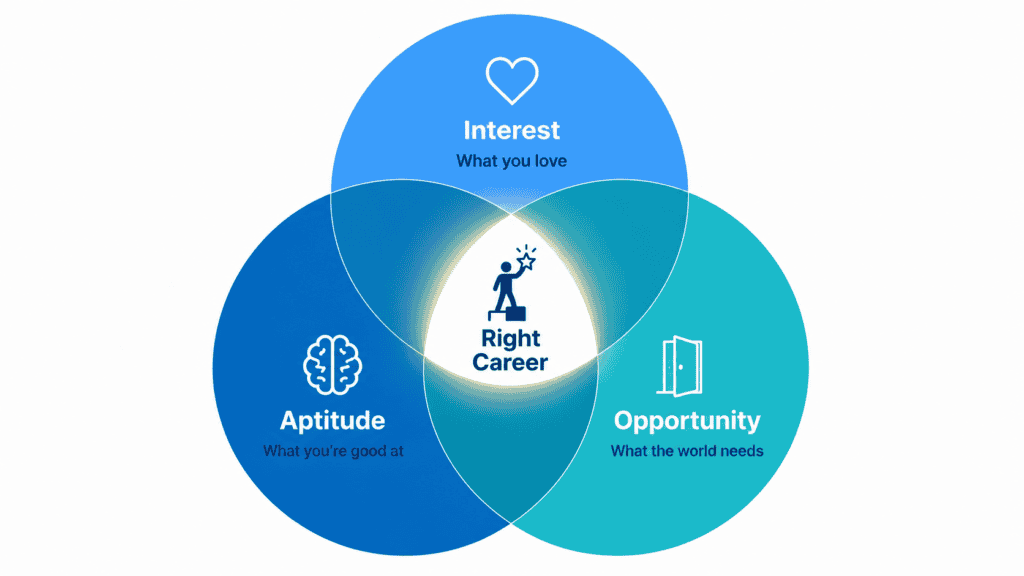
How to Know Which Career Suits My Child: The 3-Lens Method
Here’s the simplest way to find out. Look at your child through three lenses. When all three overlap, you’ve found a strong fit.
Lens 1: Interest (What pulls their attention?)
Notice what your child does when no one forces them. Do they fix things? Draw? Argue a point? Organise events? Interest is the fuel. Without it, even a “good” career feels heavy.
Lens 2: Aptitude (What comes naturally?)
Interest alone isn’t enough. Your child also needs natural ability. Some kids think in numbers. Others in words, images, or people. A quick aptitude check reveals strengths that grades alone hide.
Lens 3: Opportunity (Where is the world heading?)
Finally, match interest and aptitude with real demand. AI, healthcare, design, data, skilled trades, content—these fields are growing fast. A good fit also has a future.
When interest, aptitude, and opportunity meet, your child has both motivation and a runway. That overlap is the answer to “which career suits my child.”
What Is the Easiest Way to Find the Right Career for a Child?
The easiest way is to combine honest observation with a structured assessment. Spend one week noting your child’s natural interests and energy. Then use a career aptitude test to confirm strengths. Together, observation plus assessment gives clear, unbiased direction in days, not years.
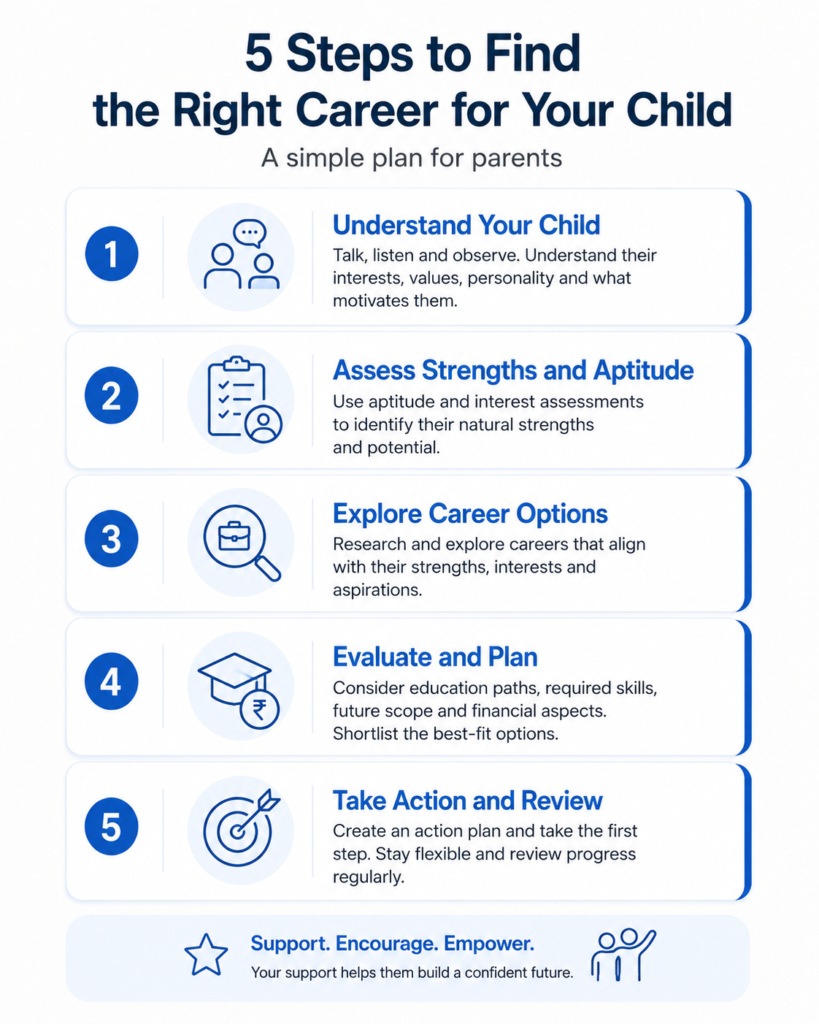
A Simple 5-Step Plan You Can Start This Week
You don’t need to be an expert. Just follow these steps.
First, observe quietly for one week. Write down what energises your child and what drains them.
Second, talk—don’t lecture. Ask open questions like “What part of school do you enjoy most?” Listen fully.
Third, run a proper aptitude and interest assessment. This removes bias and shows patterns you might miss.
Fourth, explore 3–4 matching careers together. Watch a day-in-the-life video. Talk to someone in the field.
Fifth, decide a direction, not a final destination. Pick a stream or path that keeps doors open.
This plan works because it replaces anxiety with evidence.
Want this done for you with expert eyes? A structured Ayud Career Clarity Session walks your child through a guided assessment and gives you a clear, personalised report—so you stop guessing. Book your session here.
The Mistake Most Parents Make
Here’s something I see constantly. Parents choose based on prestige or salary stories from relatives. “My friend’s son earns well in IT, so put yours in IT too.”
But your child isn’t your friend’s son. Copying someone else’s path ignores all three lenses. The result? A child who’s capable but quietly miserable—and often switches fields years later anyway.
Avoid this by trusting data about your child, not opinions about someone else’s.
A Real Story: From Pressure to Purpose
Let me return to that father in Kalaburagi. We ran a proper assessment for his daughter. The results were clear: strong in communication, creativity, and people skills—weaker in pure technical reasoning.
Engineering would have been a struggle. Instead, she leaned into design and communication. Today she’s thriving in a creative field, confident and engaged.
Her father told me later, “I almost forced her down the wrong road.” That one assessment changed her direction—and her relationship with him improved too, because she felt heard.
This is what clarity does. It turns pressure into purpose.
How Career Assessments Actually Help
A good assessment isn’t a fortune-teller. It’s a mirror. It reflects your child’s strengths back clearly, without family bias or peer pressure.
It measures interests, aptitudes, and personality patterns. Then it maps them to suitable career clusters. Globally, structured career guidance is linked to better student outcomes and lower dropout rates, according to UNESCO and OECD research on career education.
In short, assessment turns a stressful guess into an informed decision.
Frequently Asked Questions
At what age should my child take a career assessment?
Around classes 9–12 is ideal, when stream and subject choices begin. However, even college students and early job seekers benefit, because interests and strengths keep maturing.
How do I know which career suits my child if their interests keep changing?
Changing interests are normal at this age. Focus on underlying patterns—do they consistently enjoy creating, analysing, helping, or organising? A structured assessment reveals stable traits beneath shifting hobbies.
Can I find the right career without a formal test?
You can start with observation and honest conversations. But a formal assessment removes bias and uncovers hidden strengths, giving far more reliable direction in less time.
What if my child’s interest has no clear career?
Almost every genuine interest connects to a career today. Gaming links to design, testing, and esports. Talking links to law, sales, and media. The key is mapping interest to opportunity.
Is one career choice permanent?
No. A first choice sets a direction, not a destiny. Skills transfer across fields. Choosing well simply means a smoother, more confident start.
Your Next Step Toward Clarity
You don’t have to carry this decision alone, and you don’t have to guess.
Give your child the gift of clarity. Book an Ayud Career Clarity Session—a focused one-on-one where we assess your child’s interests, aptitude, and best-fit career directions, then hand you a clear plan you can actually use.
👉 Book your Ayud Career Clarity Session today — turn confusion into a confident next step, and finally know which career suits your child.
Register on Ayud Jobs & Get Hired Faster
Create your free profile, apply in one tap, and let recruiters find you. Your next opportunity is closer than you think.