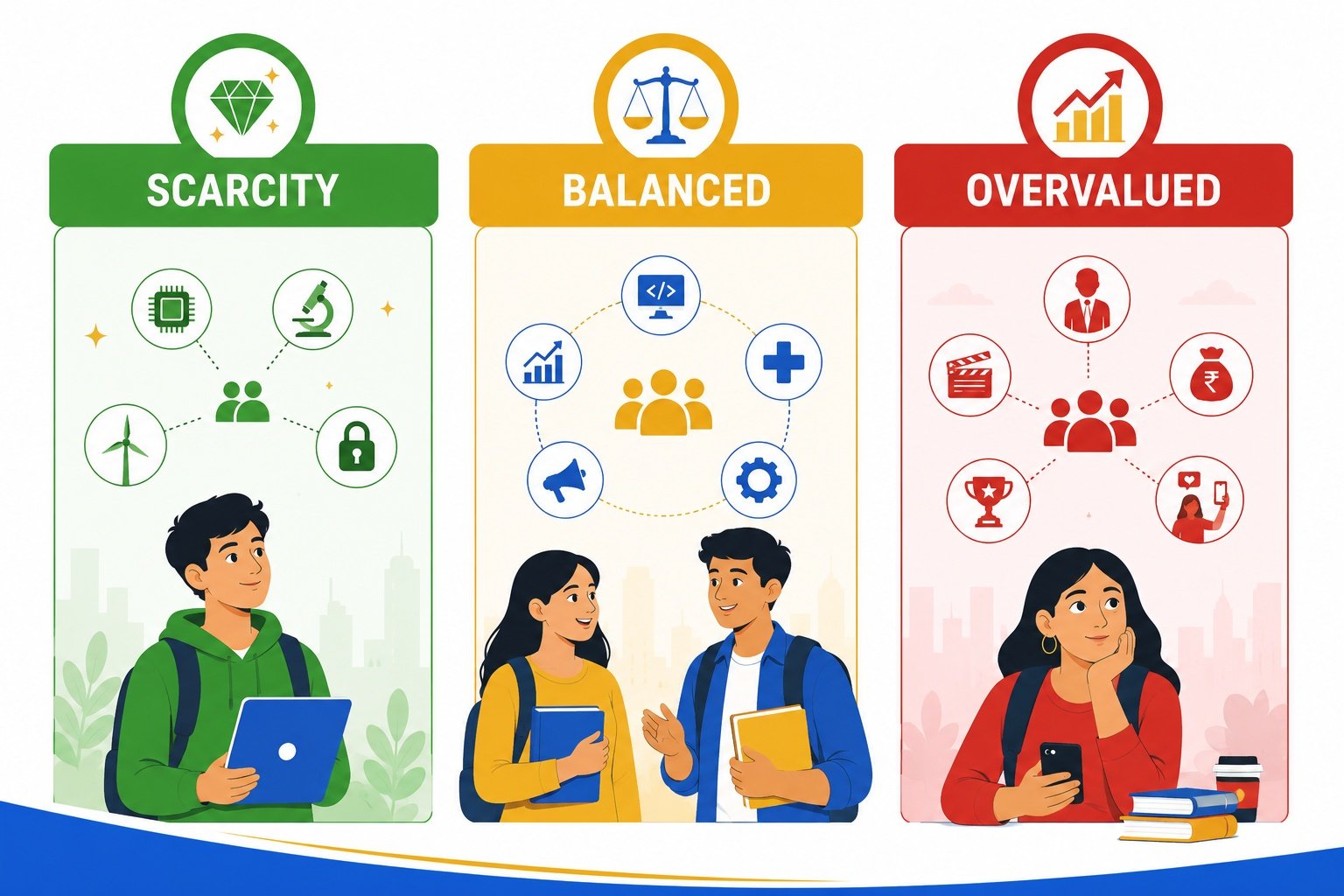
Scarcity Balanced Overvalued Careers: 2026 Map
⏱ 7 min read
Quick Answer: The scarcity balanced overvalued careers map sorts every job into three zones — Scarcity (high demand, few skilled people), Balanced (steady supply and demand), and Overvalued (everyone is chasing it, so it pays less than the hype). Per the India Skills Report 2025 (Wheebox–CII), only 54.81% of Indian graduates are employable, and the WEF Future of Jobs Report 2025 projects a net 78 million new jobs by 2030 — but only in the right zones. Use this map to pick a path that the market actually rewards.
The scarcity balanced overvalued careers framework is the simplest way I know to answer the question I hear every single week from parents in my office: “Sir, which course will get my child a job?” Most families pick a path based on what sounds prestigious, not on what the market is short of. That one mistake costs years.
I built the scarcity balanced overvalued careers map after watching hundreds of bright students graduate into fields that were already overcrowded. The India Skills Report 2025 found that just 54.81% of Indian graduates are considered employable — meaning nearly half struggle to find work that fits their degree. The problem is rarely talent. It is choosing the wrong zone.
Register on Ayud Jobs & Get Hired Faster
Create your free profile, apply in one tap, and let recruiters find you. Your next opportunity is closer than you think.
What Is the Scarcity Balanced Overvalued Careers Map?
In short, scarcity balanced overvalued careers is a demand-based lens. Instead of asking “Is this course good?”, it asks a sharper question: “How many skilled people does the market have, versus how many it needs?” That ratio decides your salary, your bargaining power, and how fast you get hired.
Every career falls into one of three zones. The goal is simple — aim for Scarcity, accept Balanced with a plan, and enter Overvalued only with eyes wide open.
| Zone | What It Means | Your Position |
|---|---|---|
| Scarcity | High demand, very few skilled people | You set the price |
| Balanced | Steady demand, steady supply | Skill quality decides |
| Overvalued | Too many people, not enough roles | The market sets the price low |
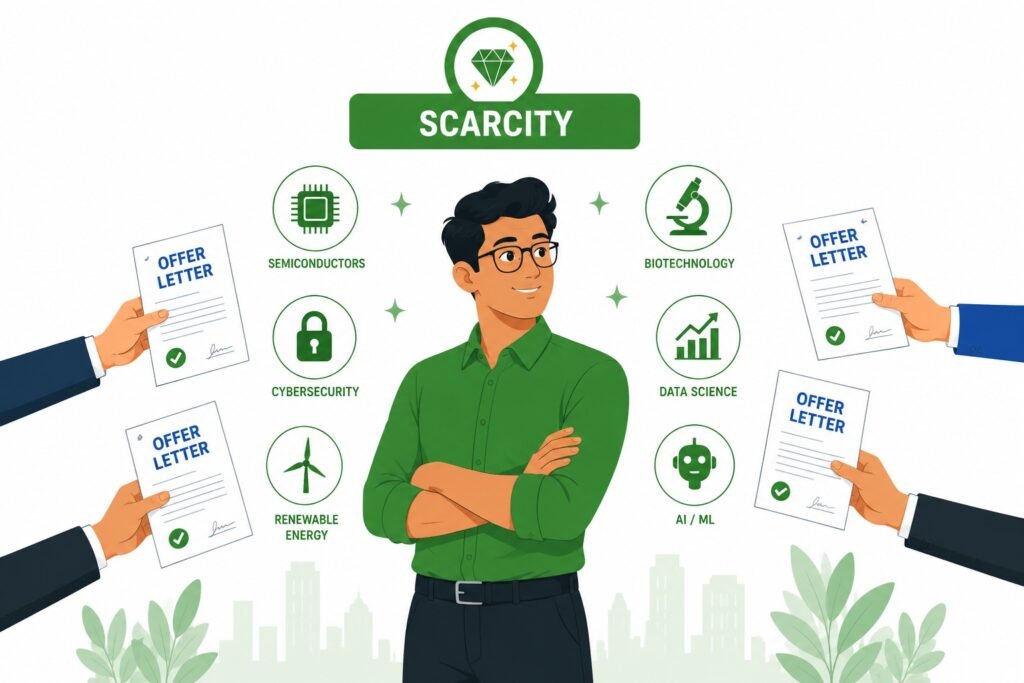
The Scarcity Zone: Where Demand Outruns Supply
In the scarcity balanced overvalued careers system, this is the green zone — and where I push most students to look first. These are roles the economy is actively short of. The WEF Future of Jobs Report 2025 names AI and machine learning specialists, big data specialists, fintech engineers, and renewable energy engineers among the fastest-growing jobs through 2030.
India backs this up. The same India Skills Report 2025 data shows technical fields like AI and machine learning are where employer demand is climbing fastest, even as overall employability stays under 55%. When few people have a skill the market badly wants, you negotiate from strength. That is the first leg of scarcity balanced overvalued careers.
The Balanced Zone: Steady, Safe, Skill-Dependent
The middle band of scarcity balanced overvalued careers holds steady demand. Think nursing, teaching, accounting, civil engineering, and skilled trades. The WEF report confirms care roles, education roles, and frontline jobs like construction and delivery will see some of the largest absolute job growth by 2030.
These careers will not vanish. But because supply roughly matches demand, your salary depends entirely on how good you are. An average accountant struggles; a sharp one who also knows data tools thrives. In this zone, the differentiator is skill quality, not the job title.

The Overvalued Zone: Crowded and Quietly Shrinking
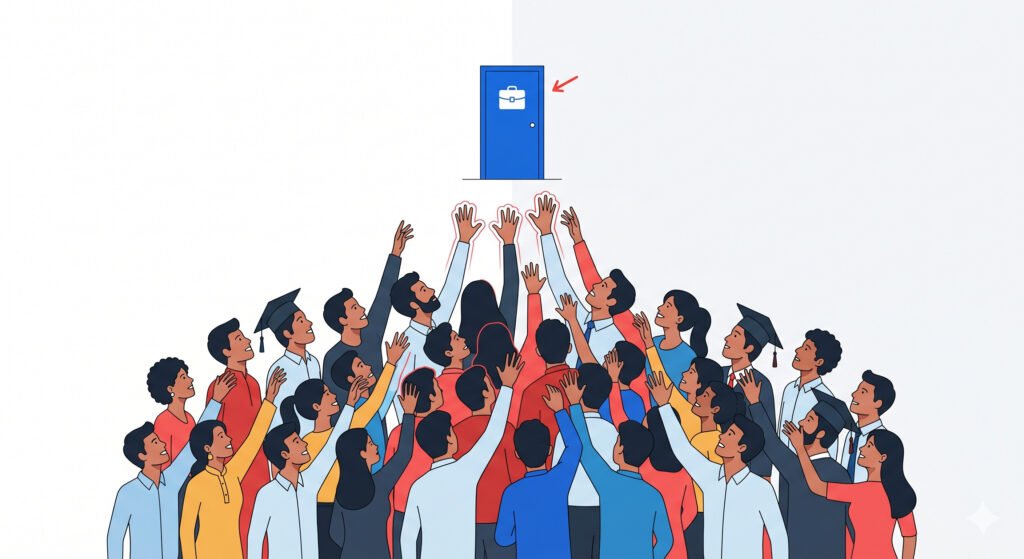
The third band of the scarcity balanced overvalued careers map is the crowded one. Here, far more graduates enter than the market can absorb, so pay drops and competition turns brutal. The WEF Future of Jobs Report 2025 lists data entry clerks, cashiers, administrative assistants, bank tellers, and — for the first time — graphic designers among the fastest-declining roles, as generative AI takes over routine work.
This zone is why scarcity balanced overvalued careers thinking matters most. Many “safe-sounding” choices are actually shrinking. The Mercer-Mettl Graduate Skill Index 2025 found digital marketing employability at just 41% and HR at 39.9% — proof that popular fields can be oversupplied. Entering here is not wrong, but you must enter as the top 10%, not the average.
How Does the Scarcity Balanced Overvalued Careers Map Work?
The scarcity balanced overvalued careers map is a three-zone tool that ranks any career by supply versus demand. Scarcity zones have few skilled people and high need, so they pay best. Balanced zones reward skill quality. Overvalued zones are overcrowded, so pay and prospects fall despite the hype.
A North Karnataka Reality Check
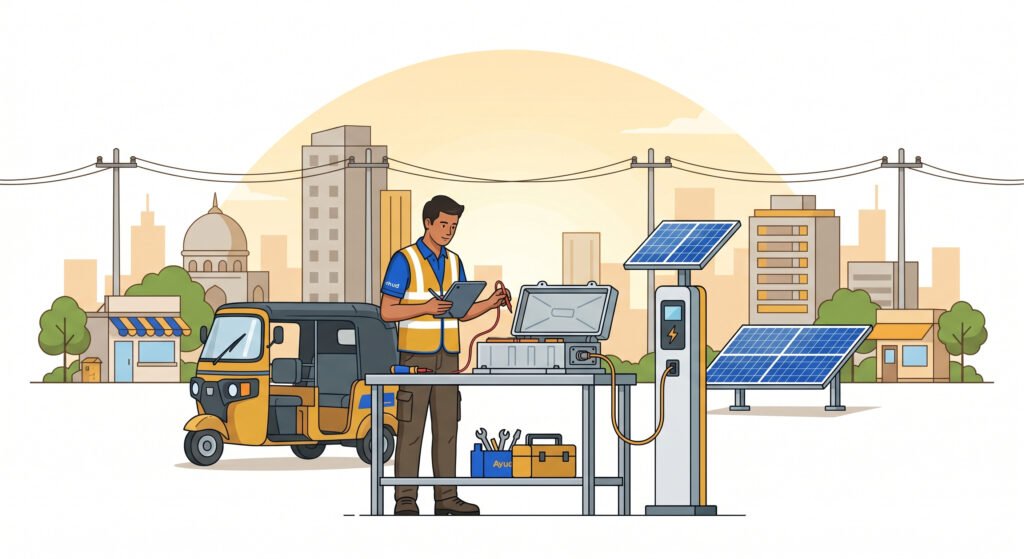
Here in Kalaburagi, the scarcity balanced overvalued careers idea plays out every week. I meet students completing ITI or polytechnic courses who assume only an engineering degree counts. Yet local industries — solar plants, EV servicing, food processing — struggle to find skilled hands. Those are scarcity-zone roles hiding in plain sight in tier-2 India.
Meanwhile, hundreds chase the same generic BBA and plain B.Com seats every year. The map does not say those degrees are bad. It says: know which zone you are entering, and add a scarce skill on top.
How to Use This Map for Your Own Choice
To apply scarcity balanced overvalued careers to your own choice, start here. First, list the careers you are considering. Second, check live demand — job portal openings, government skill-mission priorities, and the WEF growth list. Third, place each option in a zone. Fourth, if your favourite sits in the Overvalued zone, do not drop it — stack a scarce skill (AI tools, data, a trade certification) on top to move yourself up.
If you want help mapping your own strengths to these zones, our free aptitude self-assessment shows where you naturally fit before you commit money or years.
A Real Student Story
Priya’s turnaround shows scarcity balanced overvalued careers in action. She came to me set on a plain commerce degree because “everyone does it.” We ran her interests against the map. Commerce sat in the Balanced-to-Overvalued band — fine, but crowded. So she kept the degree and added a data-analytics certification, a clear scarcity skill.
Two years later she was hired as a junior data analyst at nearly double the salary her classmates were offered. Same degree. Different zone strategy. That is the whole point of the framework.
Frequently Asked Questions
How do scarcity balanced overvalued careers zones change over time?
Zones shift as technology and demand move. A scarce skill can become balanced once many people learn it. That is why I tell students to recheck the map every two years and keep upskilling. The WEF projects 39% of core job skills will change by 2030.
Is an engineering degree still a scarcity-zone choice?
Not automatically. Engineering employability is high at 71.5% (India Skills Report 2025), but the branch and your real skills decide the zone. Core AI, data, and renewable-energy specialisations sit in scarcity; generic branches without practical skills drift toward balanced or overvalued.
Are government jobs in the overvalued zone?
Often, by competition. The roles are stable, but applicant numbers per seat are enormous, which makes the effort-to-reward ratio harsh. Treat them as a high-competition Overvalued path and always keep a parallel skill-based backup.
Can a tier-2 student access scarcity-zone careers?
Absolutely. Many scarce skills — AI tools, digital trades, EV and solar servicing — are learnable online or at local ITIs without a metro-city budget. Location is no longer the barrier it once was.
Your Next Step
The scarcity balanced overvalued careers map will not pick your future for you — but it will stop you from walking blindly into a crowded zone. In a country where under 55% of graduates are employable, the right zone is the difference between chasing jobs and choosing them.
Ready to find your zone? Book a Clarity Session and we will map your strengths to live, in-demand careers together. Prefer to start free? Build a step-by-step career roadmap with Career LAB.
External sources: WEF Future of Jobs Report 2025 and the India Skills Report 2025 (Wheebox–CII).
Register on Ayud Jobs & Get Hired Faster
Create your free profile, apply in one tap, and let recruiters find you. Your next opportunity is closer than you think.