Polytechnic vs ITI: Which Is Better After 10th? 2026
⏱ 8 min read
In Short (Quick Answer)In the polytechnic vs iti choice after 10th, pick ITI if you want to start earning in 6–24 months and love hands-on trade work. Pick polytechnic (3-year diploma) if you want a Junior Engineer path, higher salary, and the option to do B.Tech later. In Karnataka, both admit on SSLC marks with no entrance exam — a government polytechnic costs about ₹4,270/year, and a government ITI even less.
Every June, parents in Kalaburagi ask me the same question about the polytechnic vs iti decision: “Sir, my son passed 10th — which one gives a job faster?” It is the single most important choice a Class 10 student in North Karnataka makes, and most families decide it based on a neighbour’s advice rather than real data.
So let me settle the polytechnic vs iti question with numbers, not opinions. I talk to these students every week, and the honest answer is that neither path is “better” — one is faster to a paycheck, the other has a higher ceiling. This guide gives you the 2026 Karnataka fees, salaries, and admission facts so you can decide for your own child, not someone else’s.
Register on Ayud Jobs & Get Hired Faster
Create your free profile, apply in one tap, and let recruiters find you. Your next opportunity is closer than you think.
Polytechnic vs ITI: The Core Difference
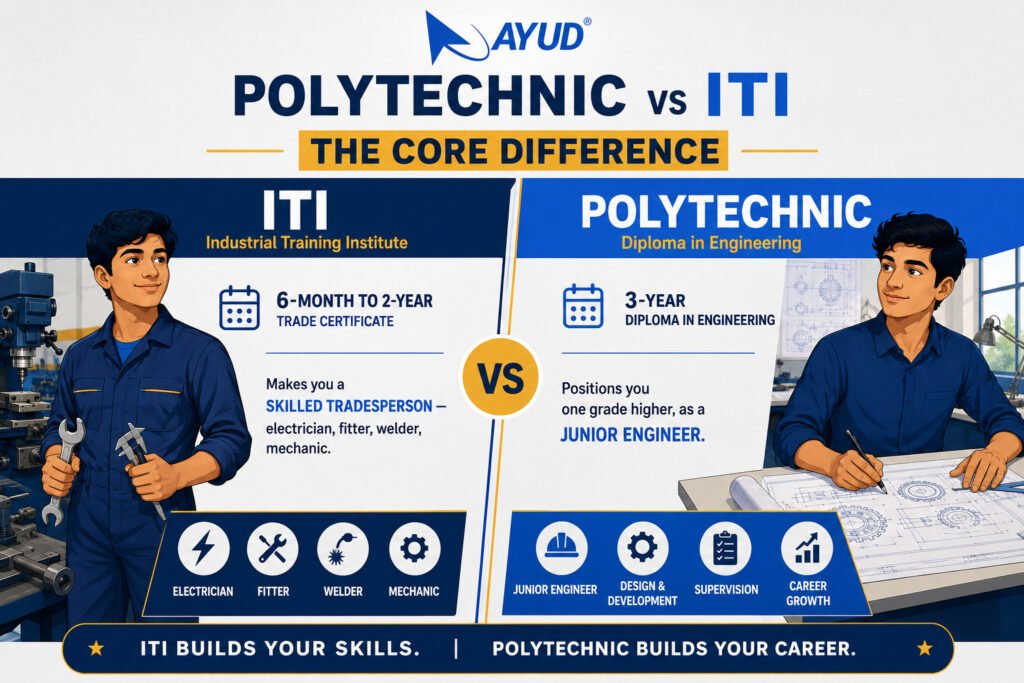
Here is the polytechnic vs iti difference in two sentences. ITI (Industrial Training Institute) is a 6-month to 2-year trade certificate that makes you a skilled tradesperson — electrician, fitter, welder, mechanic. Polytechnic is a 3-year Diploma in Engineering that positions you one grade higher, as a Junior Engineer.
According to the Directorate of Technical Education (DTE) Karnataka, both accept students straight after SSLC (Class 10) with a minimum of 35% marks, and neither needs an entrance exam for first-year admission in 2026. If you want the full step-by-step process, dates, and college list, see our complete Karnataka polytechnic admission 2026 guide. The real polytechnic vs iti split is not about difficulty — it is about how fast you want to earn versus how far you want to climb.
Comparison Table: Polytechnic vs ITI at a Glance
This is the polytechnic vs iti breakdown every Karnataka parent wants on one screen. Read it carefully — if one column pulls you, you may already have your answer.
| Factor | ITI | Polytechnic (Diploma) |
|---|---|---|
| Duration | 6 months – 2 years | 3 years |
| Entry after | Class 10 (SSLC) | Class 10 (SSLC) |
| Focus | Practical trade skill | Theory + lab + engineering |
| Qualifies you as | Skilled Technician / Craftsman | Junior Engineer |
| Govt fee (Karnataka) | ~₹2,000–₹10,000/year | ~₹4,270/year |
| Govt job pay level | Technician (Level 2): ₹28,000–₹38,000/mo | Junior Engineer (Level 6): ₹42,000–₹55,000/mo |
| Higher study | Lateral entry into Diploma 2nd year | Lateral entry into B.Tech 2nd year |
| Best for | Fast earning, hands-on trade | Engineer path, wider ceiling |
Sources: DTE Karnataka 2026; ITISkillInfo salary data (May 2026); AllIndiaGovtJobHub govt-jobs guide (2026).
Fees in Karnataka: The Honest Math
On the polytechnic vs iti cost question, both are shockingly affordable if you go government. A government polytechnic in Karnataka — like S.J. Government Polytechnic, Bangalore — charges roughly ₹4,270 per year in total fees (2025 data). A government ITI often costs even less, in the ₹2,000–₹10,000/year range. If you are leaning toward the trade route, our guide to ITI courses after 10th in Karnataka breaks down the best trades and government institutes.
The trap is private colleges. A private polytechnic can charge up to ₹1–1.5 lakh per year, and a private ITI ₹15,000–₹50,000. For most tier-2 families in North Karnataka, quality at a government seat is comparable — so the smart move is to chase a government merit seat through DTE counselling, not a costly private one. Hostel and mess (₹3,000–₹8,000/month) are extra either way if you are from a village outside Kalaburagi.
Salary: Polytechnic vs ITI Earnings in 2026
The polytechnic vs iti salary gap is real but easy to misread. A fresh ITI holder in the private sector earns roughly ₹12,000–₹18,000/month; a diploma holder earns ₹15,000–₹25,000/month — about 20–30% more (ITISkillInfo, 2026). In government jobs the gap widens: an ITI technician sits at ₹28,000–₹38,000/month, while a polytechnic Junior Engineer (RRB JE, SSC JE) starts at Pay Level 6, roughly ₹50,000–₹56,000 take-home in year one.
But here is the catch most people miss. The ITI holder starts earning 1–2 years earlier. Those two years of income partly close the salary gap. Over a 10-year career, though, the diploma holder typically moves into supervisory and JE roles, so the long-term ceiling is higher.
The Ayud Lens: Which One Is Scarce, Balanced, or Overvalued?
At Ayud we grade every path as Scarcity, Balanced, or Overvalued — not with motivation, but with honesty. On the polytechnic vs iti map for 2026:
- Scarcity (high demand, fewer takers): Specialised ITI trades — CNC Operator, Electronics Mechanic, industrial welding. India’s “Make in India 2.0” push has pulled these into genuine shortage, and Germany, Japan and Switzerland actively recruit such technicians.
- Balanced: Core polytechnic diplomas — Civil, Mechanical, Electrical, Computer Science. Steady government and private demand, with a clean B.Tech ladder.
- Watch out (Overvalued expectation): Assuming any ITI or diploma equals “government job pakki.” It does not. The certificate opens the exam door; you still have to clear RRB, SSC or state JE selection.
A Real Kalaburagi Story
Last year a boy from a village near Kalaburagi came to me stuck on exactly this polytechnic vs iti fork. His family needed income fast, so the pressure was toward ITI. But he loved understanding how machines work, not just fixing them. We looked at his SSLC marks (72%) and his temperament — a classroom-plus-workshop learner.
He chose a 3-year Diploma in Mechanical Engineering at a government polytechnic. Two years in, he is already targeting the RRB JE exam. Had he picked ITI, he would be earning today — but he would have hit a lower ceiling than the JE track he now has open. The lesson: match the path to the child, not to the panic.
Is Polytechnic Better Than ITI After 10th?
Neither is universally better in the polytechnic vs iti debate. Choose ITI if you want the fastest possible salary in a hands-on trade and have a tight budget. Choose polytechnic if you can invest one extra year for a Junior Engineer role, higher pay, and a B.Tech option. Your 10th marks, family finances, and temperament decide it — not fashion.
How to Decide in 3 Questions
Ask your child these three things:
- Speed or ceiling? Need income in 12 months → ITI. Willing to wait 3 years for a higher ceiling → polytechnic.
- Classroom or workshop? Hate theory, love doing → ITI. Comfortable with theory + labs → polytechnic.
- Trade or engineer? Want to be a skilled tradesperson or run your own service → ITI. Want JE exams and engineering roles → polytechnic.
Still unsure? A 30-minute conversation with a counsellor who has no college to sell you often settles it faster than weeks of family debate — which is exactly why families across the region come to us for career counselling in Kalaburagi.
Not sure which fits your child?
Take the free Ayud GoTestIt self-assessment to see whether a trade or an engineering diploma suits your temperament — then map the exact Karnataka route.
Frequently Asked Questions
1. Which is better after 10th, polytechnic vs iti, for a government job?
Both open government jobs, but at different levels. ITI qualifies you for Railway Group D, Technician and PSU technician posts. A polytechnic diploma qualifies you for higher Junior Engineer posts (SSC JE, RRB JE) at Pay Level 6, which pay roughly 50–70% more at entry.
2. Can I do polytechnic after ITI in Karnataka?
Yes. ITI holders get lateral entry directly into the 2nd year of a polytechnic diploma in most states, including Karnataka. Many students do ITI first, start earning, then upgrade to a diploma later.
3. Is there an entrance exam for polytechnic in Karnataka 2026?
No. DTE Karnataka admits first-year diploma students purely on SSLC (Class 10) merit through online counselling, usually opening around the SSLC result in May–June. DCET is only for lateral entry into B.Tech, not first-year admission.
4. What is cheaper in the polytechnic vs iti choice?
Government ITI is usually the cheapest, at ₹2,000–₹10,000/year. A government polytechnic is around ₹4,270/year in Karnataka. Both are dramatically cheaper than private colleges, which can cost 15–20 times more.
5. Which has better scope for the future?
Polytechnic has a wider ceiling (engineer, supervisor, B.Tech). ITI has faster earning and strong demand in specialised trades. Scope depends on the specific trade or branch, not the label alone.
Final Word
The polytechnic vs iti decision is not about which is “smarter” — it is about matching speed, budget, and temperament to your own child. In Kalaburagi and across North Karnataka, I have seen both paths produce confident, well-earning professionals. What decides success is not the label on the certificate, but how seriously you take the years that follow.
If you want a clear, commission-free reading tailored to your child’s marks and interests, that is exactly what we do. Book an Ayud Clarity Session — one honest conversation, no college trying to sell you a seat.
Register on Ayud Jobs & Get Hired Faster
Create your free profile, apply in one tap, and let recruiters find you. Your next opportunity is closer than you think.