Degree vs Diploma India 2026: The Honest Math
⏱ 7 min read
Quick Answer
The honest degree vs diploma India comparison comes down to three numbers: cost, time, and job outcome. A 4-year private B.Tech averages ₹16.8 lakh (IndiaMacroIndicators, 2025), while a government diploma like GTTC costs about ₹19,250 for the first year. Yet only around 55% of graduates are employable (India Skills Report 2025). Sometimes the cheaper, faster path wins — and sometimes it doesn’t. Here’s how to run the math for your own child.
The degree vs diploma India debate is the most emotional question I face as a career counsellor. Almost every week, a worried parent in Kalaburagi sits across from me and asks the same thing: “Sir, degree madbeku alla? A diploma looks small on the CV.” I understand the fear. But fear is not data. Let me show you the honest numbers, because the right answer changes from one family to the next.
Register on Ayud Jobs & Get Hired Faster
Create your free profile, apply in one tap, and let recruiters find you. Your next opportunity is closer than you think.
Degree vs Diploma India: What the Numbers Actually Say
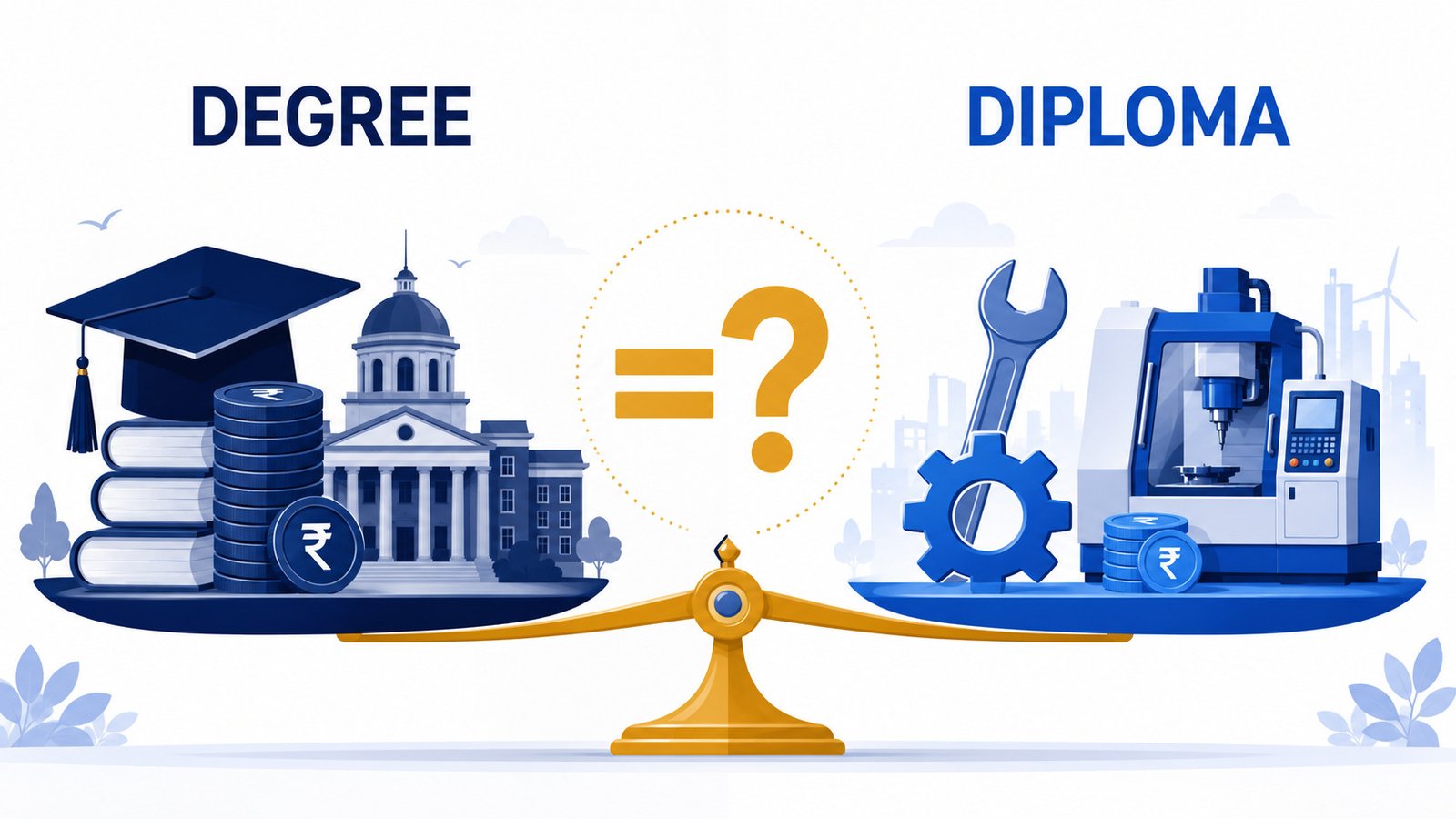
Let me start with the answer, then explain it. When you run the degree vs diploma India math honestly, the deciding factors are cost, employability, and how fast you need to earn. A degree gives you a wider ceiling and easier access to government jobs and higher studies. A diploma gives you a lower cost, a faster start, and — if it is skill-heavy — often a quicker job.
India produces roughly 1.5 million engineering graduates a year across about 3,500 institutions, and multiple studies show a large share end up unemployed or underemployed (Forbes India, 2025). A degree alone is no longer a job guarantee. This is the reality your child is walking into.
The Real Cost: Where Families Get Shocked
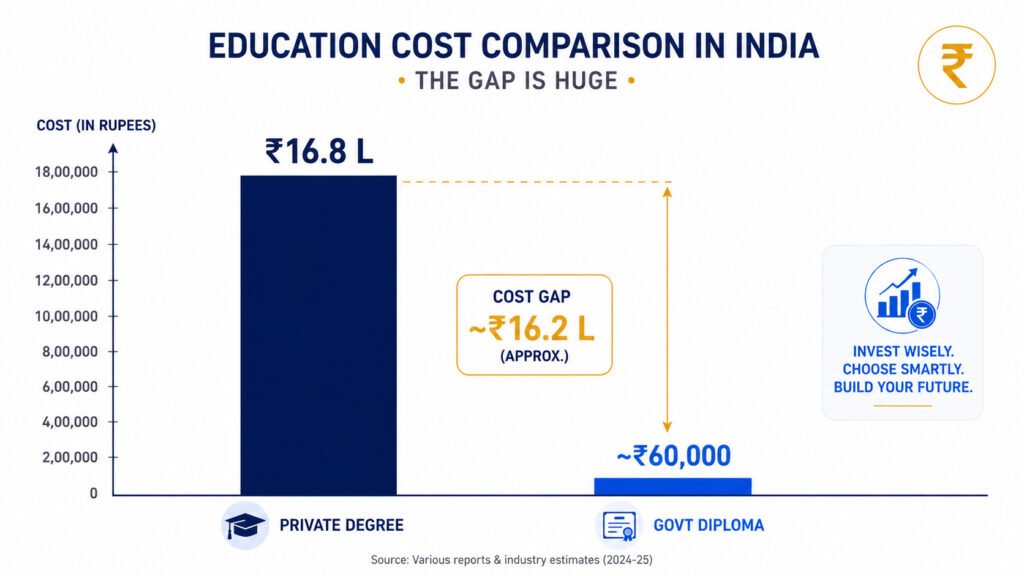
The cost side of degree vs diploma India is where most families get shocked. A 4-year B.Tech in a private college averages ₹16.8 lakh, versus ₹6.3 lakh in a government college (IndiaMacroIndicators, 2025). Add hostel, travel, and books, and a private degree can cross ₹20 lakh before your child earns a single rupee.
A skill-focused government diploma sits on the other end. GTTC Bangalore’s diploma first-year fee is around ₹19,250, with a ₹500 application fee and a ₹3,000 refundable tool deposit (GTTC, 2025). This is the part of degree vs diploma India nobody explains at the admission counter. Education loans in India have already crossed ₹1.29 lakh crore, and 40% of borrowers are stuck repaying for over 10 years (RBI, mid-2025). Debt is a career decision too.
The Salary Gap Is Smaller Than You Think
On salary, the degree vs diploma India gap is smaller than parents assume — especially in the early years. A B.Tech fresher in India averages ₹2.5–6 lakh per year (Shiksha, 2026). A GTTC diploma holder gets placed at ₹1.8–6 lakh, with the institute reporting around an 80% placement rate into companies like L&T, Volvo, Emerson, Bosch, and Wipro (KollegeApply, 2024).
Read that again. A student who spent ₹50,000 on a skill can start close to where a student who spent ₹15 lakh on a degree starts. That is the uncomfortable truth behind the ₹15-lakh degree vs the ₹50,000 skill. The degree may pull ahead later — but only if the college and branch are strong.
The Whole Thing Is an Employability Question
Here is the honest reframe: the degree vs diploma India question is really an employability question. Only about 55% of Indian graduates are employable, up from 51.2% the year before (India Skills Report 2025, CII–Wheebox–AICTE). For engineers specifically, nearly 83% of graduates fail to land a relevant job or internship straight after passing out (Forbes India, 2025).
Employers have shifted. Around 73% now prioritise hands-on experience over college pedigree (Forbes India, 2025). A diploma that teaches CNC machining, tool design, or a real trade can beat a generic degree that teaches only theory. It’s not the certificate — it’s the skill inside it.
Degree vs Diploma India: The Comparison Table
Here is the degree vs diploma India comparison in one table, so you can see the trade-off at a glance.
| Factor | Degree (B.Tech / BE) | Diploma (Polytechnic / GTTC) |
|---|---|---|
| Duration | 4 years | 3 years (2 after 12th) |
| Entry after | 12th (PCM) | 10th (SSLC) |
| Govt college cost | ~₹6.3 lakh | ~₹60,000 total |
| Private cost | ~₹16.8 lakh+ | Low / govt-funded |
| Fresher salary | ₹2.5–6 LPA | ₹1.8–6 LPA |
| Higher studies | Direct M.Tech, MBA | Lateral entry to degree |
| Govt job eligibility | Wider | Limited (some technical posts) |
| Best for | Research, mgmt, govt jobs | Fast earning, hands-on trades |
Sources: IndiaMacroIndicators 2025, GTTC 2025, Shiksha 2026, KollegeApply 2024.
A Real Karnataka Example: GTTC
For a real degree vs diploma India example, look at GTTC in Karnataka. The Government Tool Room & Training Centre, started in 1972 with Danish government support, runs diplomas in Tool & Die Making, Mechatronics, Robotics, and AI/ML across 30+ centres — including one right here in Gulbarga. Fees are tiny, and its industry partnerships mean students train on CNC and CAD/CAM machines from day one. If you want the full breakdown, read GTTC admission, fees & eligibility 2026.
The Kalaburagi Story That Changed My Mind
A few years ago, a father in Kalaburagi brought his son to me. The boy had scored 68% in SSLC. The father wanted to push for a private engineering degree on a loan. The son quietly said he loved fixing machines.
We ran the numbers together. Instead of a ₹12-lakh loan, the boy took a GTTC diploma. Within three years he was placed in an auto-component firm near Pune at ₹3.2 lakh — debt-free, while his degree-holding classmates were still job-hunting with EMIs waiting. That family made the degree vs diploma India decision the smart way: with a calculator, not with pride.
Is a Diploma Better Than a Degree in India?
A diploma is better when your child wants to earn fast, has a hands-on aptitude, or the family cannot afford a heavy degree loan. A degree is better for government jobs, research, management roles, and higher studies. The degree vs diploma India answer depends on money, mindset, and career goal — never on prestige alone.
When to Choose Which Path
The degree vs diploma India choice flips depending on your goal. Understanding where each course sits on the scarcity–balanced–overvalued career map matters more than the degree-versus-diploma label itself.
- Choose a diploma if: the budget is tight, your child is practical, or wants to start earning by age 19–20.
- Choose a degree if: you can access a strong-tier college, target government or research jobs, or plan for a master’s.
- Do both: a diploma now, then lateral entry into the second year of a degree later — the smartest low-risk path for many Tier-2 families.
Frequently Asked Questions
Is a degree or diploma better for a middle-class family in India?
The degree vs diploma India decision should start with cost, not prestige. If a degree needs a large loan and the college is average, a skill-heavy government diploma often gives a better return with far less risk.
Can I do a degree after a diploma?
Yes. Diploma holders can take lateral entry directly into the second year of a B.E./B.Tech. This is one of the best paths — you earn a skill first, then upgrade the qualification if you need it.
Do diploma holders get government jobs?
Yes, for many technical posts — junior engineer, technician, and PSU roles. But degrees open a wider door for administrative and higher-grade government positions, so match the path to your target job.
Which pays more, a degree or a diploma?
Early salaries are close. Degrees pull ahead over a 5–10 year career if the college and branch are strong, which is why degree vs diploma India is never one-size-fits-all. The skill and college quality matter more than the label.
Is GTTC diploma worth it?
For hands-on students, yes. Low fees, ~80% placement, and strong industry links make it one of Karnataka’s best-value technical paths.
The Bottom Line
The degree vs diploma India decision is math, not emotion. Don’t ask which sounds bigger. Ask which one fits your child’s aptitude, your family’s budget, and the job they actually want. A confused student who picks the wrong path wastes years and lakhs — a clear one wins either way.
Not sure where your child fits? Take our free GoTestIt self-assessment to see whether a skill-first or degree-first path suits them — or book a one-on-one Clarity Session and we’ll run the honest math for your specific situation.
Register on Ayud Jobs & Get Hired Faster
Create your free profile, apply in one tap, and let recruiters find you. Your next opportunity is closer than you think.